Also Known As:
Ali Akbar Ahmadian
Weapon Program:
- Military
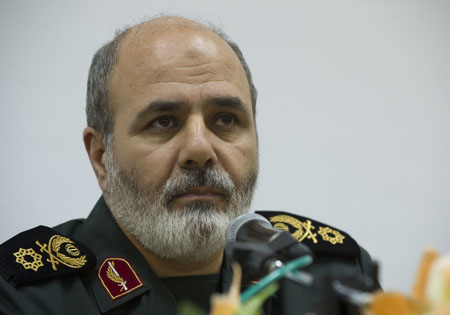
Former Chief of the Islamic Revolutionary Guard Corps (IRGC) Joint Staff.
Became commander of the IRGC Navy in August 1997; reportedly appointed Chief of the IRGC Joint Staff in July 2000 and was replaced by Brigadier General Mohammad Hejazi in September 2007; reportedly became head of Imam Hussein University (IHU) in October 2005 and left the university in July 2007; reportedly appointed head of the IRGC Strategic Studies Center in September 2007.
Born in 1961 in Kerman, Iran.
Sanctions
Designated by the U.N. Security Council on March 24, 2007, pursuant to resolution 1737 (2006), as a person involved in or supporting Iran's proliferation-sensitive nuclear activities or development of nuclear weapon delivery systems; with some exceptions, the designation requires states to freeze assets that are owned or controlled by the person, directly or indirectly, and to ensure that assets are not made available to the person; the resolution also calls on states to prevent the person from entering or transiting through their territories.
Previously removed from the U.N. list on October 18, 2023, following the expiration of targeted sanctions on Iran; returned to the U.N. list on September 28, 2025, as part of the reimposition of sanctions on Iran.
Listed by the European Union on April 21, 2007, as a person linked to Iran's proliferation-sensitive nuclear activities or Iran's development of nuclear weapon delivery systems; with some exceptions, E.U. member states must freeze assets owned or controlled by the person, directly or indirectly, prevent assets from being made available to the person, and prevent the person's entry into or transit through their territories.
Added on October 25, 2007, to the Specially Designated Nationals (SDN) list maintained by the U.S. Department of the Treasury's Office of Foreign Assets Control (OFAC), freezing the person's assets under U.S. jurisdiction and prohibiting transactions with U.S. parties pursuant to Executive Order 13382, which targets proliferators of weapons of mass destruction (WMDs) and their delivery systems; also designated on October 31, 2017, pursuant to Executive Order 13224, which targets terrorists and those providing support to terrorists or acts of terrorism; also subject to the Iranian Financial Sanctions Regulations, which restrict the use of the U.S. financial system for transactions involving Iranian entities.
Foreign parties facilitating transactions for the person or otherwise assisting the entity may be subject to U.S. sanctions; foreign financial institutions facilitating transactions for the person may be prohibited from opening or maintaining correspondent or payable-through accounts in the United States; also subject to heightened U.S. export license requirements (with a presumption of denial) due to involvement in activities related to terrorism and WMD proliferation.
Sanctioned by the governments of Australia, Canada, Japan, and the United Kingdom, restricting business and financial transactions with the person and/or freezing the person's assets in those countries.