
Publication Type:
- Newsletters
This month’s newsletter features a table outlining the basic capabilities of Iran’s drone fleet. Iran’s drone program has evolved over decades as a key component of the country’s asymmetric warfare strategy, and the resulting necessity-driven industry has become a valuable asset to Tehran at a time when drones are rapidly reshaping warfare. The table is the first entry in Iran Watch’s new background resource on Iran’s drone program, which builds on several years of Wisconsin Project research focused on drone-related topics.
The newsletter also features profiles of entities involved in procuring drone engine components from China for the Islamic Revolutionary Guard Corps (IRGC), as well as news about the Iranian military’s evolving drone tactics, the United Arab Emirates (UAE)’s suspension of commercial ties with Iran, and a reshuffle of senior leaders in the IRGC and Iran’s security decision-making bodies. Additions to the Iran Watch library include official statements and documents related to the United States’ new effort to isolate Iran economically, diplomatic activity between Iran and the Gulf states, and other U.S. sanctions announcements and enforcement efforts.
Sign up to receive the newsletter in your inbox.
___________________
PUBLICATIONS
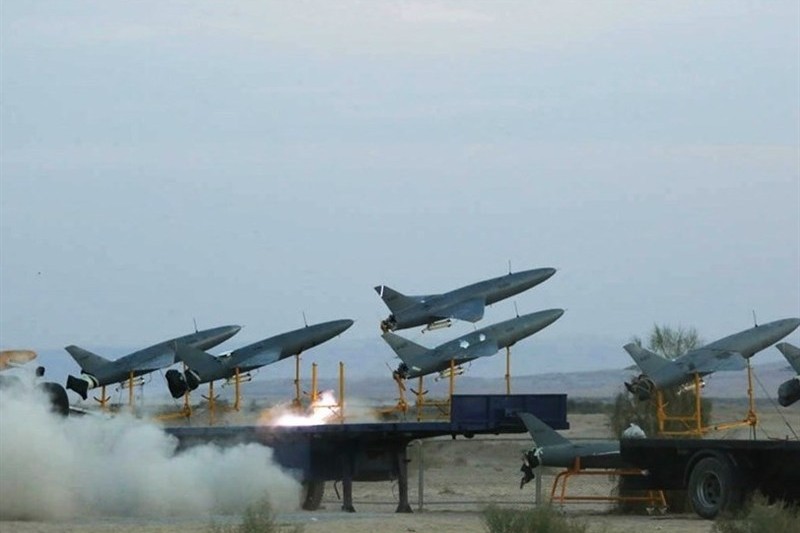 Iranian Arash-2 drones take off from a launch site. (Image Credit: Tasnim News Agency)
Weapon Program Background | Table of Iran's Drone Fleet
Iran has a large and varied unmanned aerial vehicle (UAV) arsenal, which it has frequently deployed in combat. The Iranian drone program originated during the Iran-Iraq War in the 1980s and has since continued to evolve as a key component of Iran’s asymmetric warfare strategy to compensate for Tehran’s longstanding disadvantage in conventional manned aircraft. The resulting necessity-driven industry has become a valuable asset to Iran at a time when drones are rapidly reshaping warfare.
This table presents open-source information on UAV models in active service that Iran could use to carry out or enable a strike beyond its borders. Capabilities covered include armament, range, endurance, flight ceiling, maximum speed, and propulsion systems.
___________________
ENTITIES OF CONCERN
Although Iran has the ability to assemble drone engines domestically, Iranian companies operate procurement networks in China to obtain foreign parts.
An Iran-based company that produces the engines for Shahed-131 and Shahed-136 UAVs developed by Shahed Aviation Industries for the IRGC Aerospace Force; reportedly manufactures UAV engines reverse-engineered from foreign models.
A Chinese national involved in a procurement network supporting Oje Parvaz Mado Nafar Company; makes travel arrangements for Mado employees visiting China and coordinates meetings between Iranian defense officials and their China-based suppliers.
Qian Xi Long Trading Co Limited
A Hong Kong-based company owned by Ma Jie that has been involved in facilitating millions of dollars' worth of transactions; sent and received hundreds of thousands of dollars in payments to companies in Turkey and Hong Kong, including for engine components.
___________________
IN THE NEWS
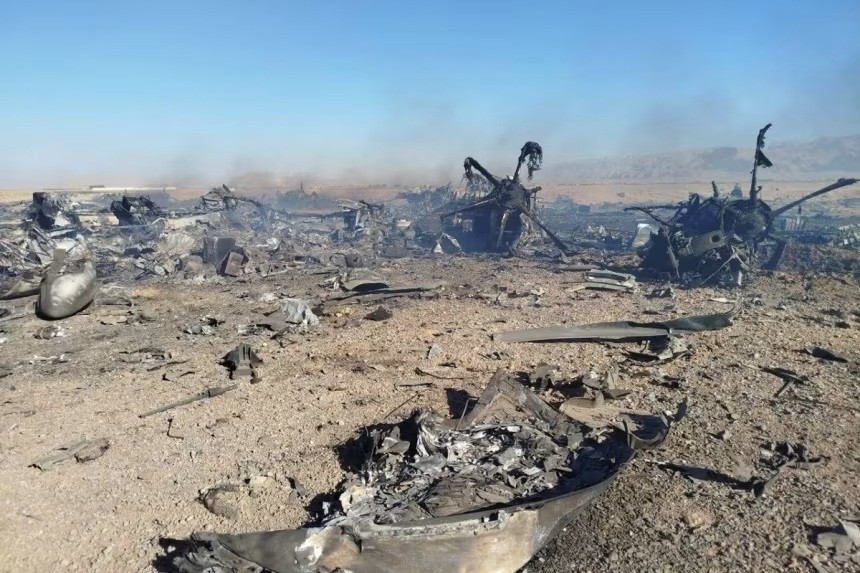 An image shown on Iranian state media claiming to show the wreckage of U.S. military aircraft downed near Esfahan, Iran. (Photo Credit: Islamic Revolutionary Guard Corps via SepahNews)
How Iran Adapted Its Attacks as U.S. War Munitions Dwindled | New York Times
August 11, 2026: Iran has adapted its military tactics by launching sustained combined drone and missile attacks and using drone swarms to gather targeting information. In July, Iranian forces launched successive waves of drones and ballistic missiles at a U.S. base in Jordan over five consecutive days. The repeated attacks caused U.S. forces to expend Patriot interceptor missiles, enabling an Iranian missile to penetrate air defenses and kill three U.S. soldiers on the fifth day. More than 100 other troops were wounded and several aircraft were also damaged in Jordan that week. In April, Iranian forces used a swarm of loitering drones to acquire and transmit the location, speed, and direction of a U.S. F-15 aircraft in Iranian airspace, enabling it to be shot down by a shoulder-fired air defense missile.
UAE Suspends Trade with Iran After Saying It Fired Missiles at Gulf State | Financial Times
August 18, 2026: The United Arab Emirates (UAE) announced that it was suspending all trade, commercial, and financial exchanges with Iran following an Iranian missile attack near its coast. The country's defense ministry said that two ballistic missiles had been launched from Iran to target maritime traffic, and that one fell into the sea inside Emirati territorial waters. It was the first attack to trigger an emergency phone alert in the UAE since June, although the UAE accused Iran of attacking ships operated by its national oil company in the Strait of Hormuz earlier in August. Prior to the attack, Iran and the UAE had resumed some diplomatic and economic exchanges, including Iranian flights to Emirati airports.
Iran’s Mysterious Ruler Signals a Hard Line on Trump with New Leadership | Wall Street Journal
August 10, 2026: Iranian Supreme Leader Mojtaba Khamenei appointed several new senior military and security leaders. Former Islamic Revolutionary Guard Corps (IRGC) commander Mohsen Rezaei replaced Mohammad Bagher Zolghadr as secretary of the Supreme National Security Council, Iran's highest security decision-making body. Rezaei had commanded the IRGC during the Iran-Iraq War. Hossein Taeb was appointed commander of the Basij paramilitary force, a position he held during the suppression of domestic protests in 2009. Ahmad Vahidi was also confirmed as the overall commander of the IRGC, and four other commanders were also formally appointed, including the commander of the IRGC Navy.
__________________
FROM THE LIBRARY
The United States announced “Operation Economic Outcast” to disrupt the foreign commercial and financial ties sustaining Iran’s economy.
- The Treasury Department imposed secondary sanctions on new sectors of the Iranian economy and froze the assets of almost 60 entities located around the world – August 24
- The new secondary sanctions apply to the aviation, digital asset, gold, shipping, and technology sectors of the Iranian economy – August 24
- The Treasury Department indefinitely suspended several sanctions exceptions related to remittances and professional and educational activities – August 24
- The State Department sanctioned senior Iranian military leaders and entities involved in oil and petrochemical exports – August 24
- The Treasury Department’s Office of Foreign Assets Control updated an alert warning of sanctions risks related to Iranian demands for vessels transiting the Strait of Hormuz – August 24
- China’s foreign ministry appeared to dismiss the implied threat of escalated U.S. secondary sanctions against it – August 25
Iran and its Gulf neighbors carried out their own negotiations and diplomatic signaling, as did several Western governments.
- Iran’s foreign ministry said that any agreement it reached with Oman on navigation for the Strait of Hormuz would not necessarily end Iranian attacks on commercial vessels – August 5
- Thirty-two Western governments and the European Union published a joint statement condemning Iran’s executions of protesters – August 12
- The UAE denounced an Iranian drone attack on the office of the head of Iraq’s Kurdistan Regional Government – August 18
- The UAE declared that it had halted trade and financial transactions with Iran following military escalation in the Gulf – August 19
- Iran and Oman released a joint statement indicating progress in their negotiations to establish a navigational corridor through the Strait of Hormuz – August 25
The United States took a number of sanctions and law enforcement actions earlier in the month.
- The United States announced sanctions related to Iranian airline Mahan Air for its logistical support to the IRGC – July 30
- The Treasury Department froze the assets of several Iranian and third-country entities involved in an Iranian shadow banking network – August 7
- The Treasury Department also targeted an international network of cryptocurrency exchanges providing financial services to the IRGC – August 7
- The Department of Justice indicted 17 Iranians for their role in carrying out cyberattacks on targets in the United States and abroad – August 18
- The Treasury Department sanctioned 10 individuals for transferring funds to Hezbollah in connection with the IRGC Qods Force – August 20