
Publication Type:
- Articles and Reports
Weapon Program:
- Drone
- Military
Related Country:
- China
- Germany
- Hong Kong
- Russia
- Turkey
- Yemen
Shahed drones have been the iconic symbol of arms proliferation in recent years. Their spread, encompassing a geographic arc from the Red Sea to the Volga River, has also been one of the most consequential and instructive proliferation cases in the past decade. This report traces the history of Iran’s and, subsequently, Russia’s efforts to procure and mass-produce the German-designed engines that power Shahed suicide drones and the role played by Chinese investors in making those engines available to them. It then outlines the policy lessons that can be drawn from the engines’ proliferation and offers recommendations to prevent similar developments from occurring in the future.
Table of Contents
- Introduction: The Shahed-136 and Its Consequences
- How the Proliferation of the L550E Unfolded
- Counterproliferation Lessons
- Network Map
Introduction: The Shahed-136 and Its Consequences
The Iranian-designed Shahed-136 suicide drone and its various knockoffs and close relatives[1] are not weapons of mass destruction (WMD) in the usual sense—they are cheap cruise missile substitutes that carry a conventional warhead less powerful than a standard 155mm artillery round[2]—but they have caused a massive amount of destruction. Iran used them to wreck Saudi Aramco oil facilities in 2019, reportedly halving Saudi Arabia’s oil output temporarily;[3] the Houthis have used them to attack commercial vessels in international waterways, sharply reducing trade through the Red Sea from late 2023 onward;[4] and Russia uses them almost nightly to terrorize Ukrainian cities and cripple Ukraine’s electricity grid.[5]
Although Shahed-136s were designed by Iran (specifically, by the Islamic Revolutionary Guard Corps (IRGC)’s Shahed Aviation Industries, from which they derive their name), they are not built from scratch with materials available in Iran, Russia, or Yemen. They require a supply of imported electronic components to power their sensors and navigation systems. Most importantly, they use a piece of Western technology to get in the air and fly: a Limbach 550E (L550E) piston engine designed by a small German aircraft motor company established in 1963.[6]
The circumstances by which first Iran and then Russia were able to acquire, copy, and then use the L550E for the large-scale production of Shahed-type drones show the growing importance of export controls on widely-traded dual-use goods (i.e., goods with both civilian and military applications), including controls on the transfer of knowledge necessary to make them. Crucially, the Limbach case also shows the need for those controls to have a geographic scope beyond just the end-use countries, the importance of screening foreign investments in firms that produce dual-use goods, and the imperative of holding the owners and affiliates of sanctions-evading companies to account.
While the Limbach proliferation case is complex and gaps remain in our knowledge of it, the basic outline becomes clear through an analysis of open sources: Proliferation of the L550E, and with it the Shahed-136, quietly ramped up in parallel with a Chinese company’s acquisition of the Limbach firm before bursting into the world’s view with Russia’s 2022 invasion of Ukraine, Tehran’s decision to supply Moscow with drones, and Russia’s successful push to mass produce its own version of the Shahed-136—with that Chinese company’s help.
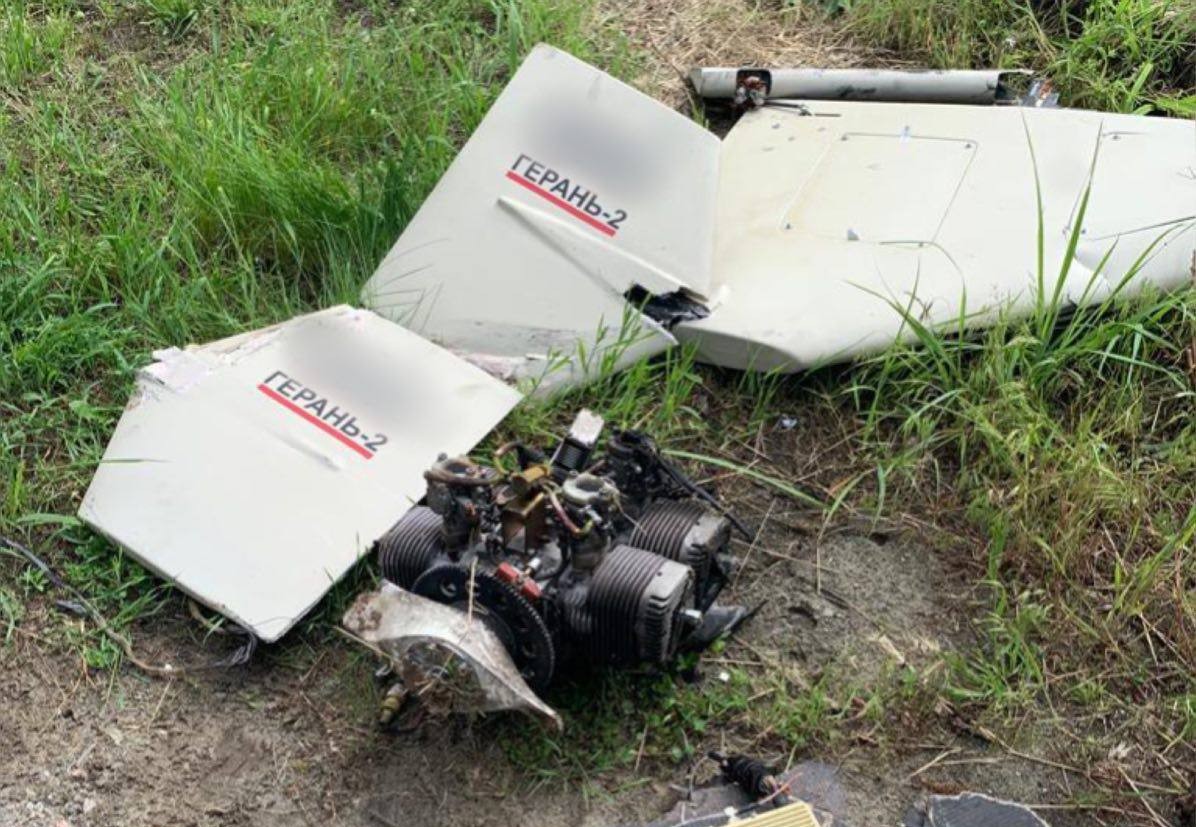 An L550E engine amid wreckage of a Russian Geran-2 (Shahed-136) drone recovered in Kharkiv, Ukraine in 2023. (Photo Credit: Kharkiv Region Prosecutor’s Office)
How the Proliferation of the L550E Unfolded
Iran’s Early Illicit Procurement Efforts and Drone Development
Iran first showed an interest in Limbach’s engines in 2005-2006, when it likely illicitly acquired as many as 34 L550E engines through front companies in the Netherlands and Taiwan, according to leaked U.S. diplomatic cables. The State Department believed that Iran continued to seek L550Es through a United Arab Emirates-based front company in 2007-2008. The United States suspected that the engines were being sought for drone projects by state-owned aircraft producer Iran Aircraft Manufacturing Industries (HESA), and German authorities reportedly opened an investigation into Limbach Flugmotoren GmbH over the 2005-2006 exports. These early Iranian efforts followed a traditional illicit procurement pattern, with the intermediary companies falsifying export licensing documents and shipping the engines to Iran through third countries in the Middle East.[7]
In 2010, IRGC-linked Iranian drone entrepreneur Yousef Aboutalebi claimed to have reverse-engineered drone engines comparable to American, British, and German models.[8] By March 2011, his company, Mado, was advertising copies of the Limbach L550E and L275 engine models, which it labeled as MD550 and MD275, respectively.[9]
In February 2012, Ababil-3 reconnaissance drones produced by HESA began to be seen over Syria.[10] One that was downed by anti-Assad rebels in June 2013 contained what appeared to be the Mado MD550 copy of the L550E engine.[11] Their numbers were relatively few, however: according to open-source research, only 51 Ababil-3 sightings were reported in Syria between 2012 and 2013.[12] Because the Ababil-3 is a reusable platform, a smaller number of drones likely accounted for the sightings.
It was not until December 2014 that Iran displayed a delta-wing suicide drone resembling the later Shahed-136 and -131 models.[13] The drone then disappeared from public view for five more years, reemerging only in 2019. The reason for the lag is unclear, but it is possible that the supply of engines or other components was a constraint. A small fleet of reusable reconnaissance drones like the Ababil-3 could be maintained using the engines Iran had illicitly imported or with small-scale production of reverse-engineered copies as components became available. An effective arsenal of single-use drones like the Shahed-136 would require mass production based on a steady supply of inputs.
The Takeover of Limbach and Iran’s Drone Dealings in China
A corporate transaction in Germany began a process that may have helped free Iran of supply constraints and later enabled Russia to mass-produce Shahed-136 derivatives. Limbach Flugmotoren appears to have spent its first several decades as a family-owned business. In December 2011, however, the family sold the business to Shuide Chen,[14] a Germany-based businessman who hails originally from Xiamen, China.[15] A few months later, in May 2012, a company named Fujian Delong Aviation Technology was established in Xiamen. Its majority shareholder was (and remains) an individual named Congming Chen, and its board of directors includes several other people with the same surname.[16] In November 2012, Congming Chen established Xiamen Limbach Aircraft Engine Co. as a producer and distributor of Limbach engines in China.[17]
Another series of company registrations, seemingly unconnected, subsequently unfolded in Iran and China. In May 2013, Aboutalebi formally established Oje Parvaz Mado Nafar Company (Mado) in Iran. Its chairman was Abdollah Mehrabi, the commander of the IRGC Aerospace Force’s research and development unit.[18] By September 2013, Beijing Micropilot UAV Flight Control Systems, a Beijing-based drone company that had been in business since 2002, began to advertise MD550 and MD275 engines on its website,[19] reportedly making it the only company other than Mado to do so.[20]
In October 2013, Aboutalebi established a trading company in Hong Kong, Mado Import and Export Company, with help from a China-based individual named Ma Jie.[21] Then, in July 2014, Beijing Micropilot established its own branch in Hong Kong.[22] Iranian entities commonly use companies in Hong Kong to process payments for their transactions in China, circumventing U.S. financial sanctions on Iran.[23]
When the Shahed-136 precursor appeared in Iran in December 2014, however, there was no apparent thread connecting Limbach Flugmotoren, Fujian Delong Aviation, Xiamen Limbach, Beijing Micropilot, and Mado other than the sequential chronology of their corporate actions and the Limbach engines themselves. It seemed plausible—and remains possible—that Aboutalebi and Mado were successful enough in reverse-engineering the engines they had obtained in the early 2000s and establishing a domestic supply chain for needed components that they were able to produce more engines indigenously than their Iranian military clients needed, and that they were selling the surplus on the Chinese market through Beijing Micropilot primarily for profit.
Subsequent developments cast doubt on that scenario, however. First, in 2017, Fujian Delong Aviation acquired Limbach Flugmotoren outright, and Congming Chen kept Shuide Chen as the German company’s managing director.[24] The move clarified that Limbach was being run as a Chinese-owned family of companies under the direction of Congming Chen. It also meant that the supply chains and know-how necessary to produce Limbach engines likely were (and continue to be) shared between the German and Chinese branches of that corporate family.
Second, information recently published by the U.S. Treasury Department indicates that Mado has been buying engine-related goods from China, not just selling its own products there. According to the Treasury, Qian Xi Long Trading Co., a Hong Kong company founded in 2012 by Aboutalebi’s Chinese business partner and Mado fixer Ma Jie, received hundreds of thousands of dollars over the years from several apparent front companies based in Turkey[25]—a money-laundering tactic commonly used by Iran to pay its foreign suppliers.[26] Recently, Qian Xi Long Trading also sent more than $450,000 to another Hong Kong company to purchase aluminum alloy castings and spark plug caps, two items used for manufacturing engines.[27]
Third, an Emirati press report in 2020 claimed, citing intelligence reports, that Iran was smuggling drone engine technology to the Houthis from the city of Xiamen after Germany’s domestic intelligence service cracked down on illicit aircraft engine exports from Germany following an incident in 2015.[28] The report did not name the smugglers or their suppliers, but it is noteworthy that Limbach has had a presence in both Germany and Xiamen since 2012.
Meanwhile, Shahed suicide drones were making their debut. In September 2019, the Shahed-131 was used in the attack on Saudi oil facilities,[29] which was claimed by the Houthis but believed by the United States to have been orchestrated by Iran.[30] The Shahed-131 is smaller than the Shahed-136 and does not use a Limbach engine,[31] but the U.N. Panel of Experts on Yemen matched its debris to another Western-designed engine sold by Mado and Beijing Micropilot.[32] In March 2021, the Houthis displayed a Shahed-136 copy called Waid-2 at a military exhibit in Sana’a.[33] And in July 2021, Iran used a delta-wing suicide drone to attack the Israeli-linked ship MV Mercer Street in the Gulf of Oman.[34]
The available evidence does not prove that the Limbach family of companies sold engines or components to Mado or other Iranian entities, much less knowingly. Yet the circumstantial evidence indicates that Mado’s Chinese operations funneled engine-related goods to Iran from the Chinese market, where Limbach was an active player. Limbach’s owners knew that Iran had sought its products in the past, and—insofar as most businesses seek to secure their intellectual property and reputations as well as monitor their competition—it seems likely they would have known since at least 2013 or 2014 that Mado-branded copies of Limbach’s engines were being advertised in both Iran and China and used in Iranian military drones. That knowledge should have triggered precautions. But, as events in Eastern Europe would soon show, caution did not appear to be foremost on Congming Chen’s mind.
The Ukraine War and Proliferation to Russia
The Shahed-136 came into its own after Russia invaded Ukraine in 2022, and Xiamen Limbach was implicated in supplying L550E engines for it. Iran began to supply Russia with Shahed-136s in the fall of 2022 and helped Russian companies establish a factory to manufacture them in the Alabuga Special Economic Zone located on a tributary of the Volga River in the Russian region of Tatarstan. By mid-2023, the Alabuga plant was mass-producing Shahed-136 drones relabeled with the name Geran-2.
Iran’s role in Russia’s production declined over the course of 2023, and in the second half of that year Russia cut out the middleman and began to produce a Shahed-136 derivative called Garpiya with components sourced directly from China. Russian military-industrial company Izhevsk Electromechanical Plant Kupol (IEMZ Kupol), which oversees Garpiya drone production, purchased the necessary L550E engines from Xiamen Limbach using intermediaries in both China and Russia.[35] These suppliers, including Xiamen Limbach, were all sanctioned by the United States in October 2024 and by the European Union in December 2024.[36] Notably, in its justification for listing Xiamen Limbach, the European Union said it suspects the company of having shared the L550 design with entities involved in producing Shahed-136 engines.[37]
The proliferation of Limbach engines did not end with Russia. Since the October 7, 2023, Hamas terrorist attack on Israel and the ensuing Israel-Hamas war, the Houthis have frequently used Shahed-136 drones to attack commercial ships transiting the Red Sea.[38] In addition, the U.N. Panel of Experts on Yemen identified a Limbach L275 engine produced by Mado that was recovered from a Houthi drone used to strike Tel Aviv in 2024.[39]
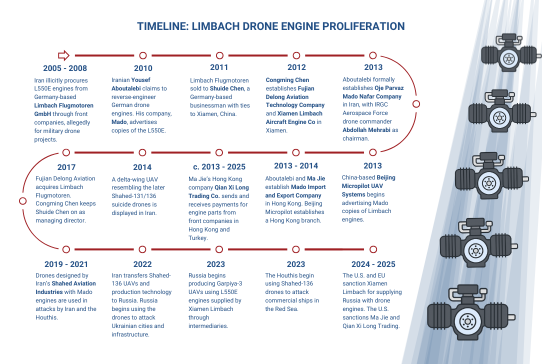 Credit: Wisconsin Project. Click the image to open an enlarged version in a new tab.
The Limbach engine proliferation case involved parallel developments unfolding on two continents over two decades, but its basic outline is nonetheless clear. A German company whose dual-use goods were already being sought by Iran was acquired by a Chinese firm, at first through a Germany-based businessman with connections to China and then outright. In parallel, Iran scaled up its use of the company’s engine models in its military drones, which it proliferated to the Houthis and Russia. When Russia cut out the Iranian middleman, Limbach’s Chinese owners were seemingly willing to oblige it by selling engines to the Russian end user from their Xiamen branch.
By the time that Chinese branch was sanctioned in 2024, the cat was out of the bag. Xiamen Limbach presumably has the designs and knowledge it needs to continue producing the L550E and other engines in China despite sanctions, and Mado may have the ability to manufacture the engines independently in Iran, too (i.e., without relying heavily on components imported from China or elsewhere). The important questions, then, are whether the proliferation of Limbach engines could have been prevented in the first place and how to prevent a similar leak of Western dual-use technology in the future.
The engines’ proliferation at scale, likely beginning sometime between 2013 and 2017, seems to have been driven by two interlinked methods that went beyond traditional smuggling: foreign investment resulting in the acquisition of the German company by a Chinese buyer and, correspondingly, the transfer of technology, some of it likely in the form of knowledge, that enabled the engines and their parts to be produced in China and possibly in Iran.
Limbach’s products were not cutting-edge technology and would not have been considered highly sensitive for export to China in the 2010s. Shuide Chen’s 2011 purchase of Limbach Flugmotoren may not have raised any red flags. However, Fujian Delong Aviation’s subsequent acquisition of the company in 2017 should have raised some, namely Iran’s past efforts to illicitly acquire L550E engines and the appearance of Mado-branded copies of those engines on the Chinese market in 2013.
Today, the case for intervening in such a transaction is clearer. China is increasingly aligned with Russia and Iran and is a major conduit of dual-use goods to them; the risks of intangible technology transfers (ITT) are more widely appreciated and more tightly controlled; and goods that are below traditional export control thresholds are now understood to pose proliferation risks. There are useful lessons to be learned and policy steps that could be taken to lower the odds of a repeat of the Limbach engine scenario.
Applying Aspects of Export Controls on Iran and Russia to China
The first takeaway is not unique to the Limbach case. It is that no export control regime aimed to obstruct the acquisition of dual-use goods by Iran or Russia can be effective unless it also controls the export of those goods to China. How to do so without a decoupling of the Chinese and Western economies is a difficult question with inevitable economic and security tradeoffs.
A February Iran Watch report offers a proposal for a modified Destination of Diversion Concern designation that would impose licensing requirements for exports of dual-use goods to Chinese companies that meet criteria associated with common red flags for export control violations, such as a recent registration date or being a sole proprietorship. The first requirement, for instance, would have brought Xiamen Limbach under scrutiny had it sought to import engines from Limbach Flugmotoren shortly following its establishment in late 2012. That may not ultimately have prevented Xiamen Limbach from producing L550E engines in China, but it may have delayed it—as well as Iran’s Shahed drone development and/or production timelines.
Foreign Investment Screening for Common Dual-Use Goods Manufacturers
The second lesson is that, as the European Commission has stated, “Investment screening complements dual-use export control.”[40] This is particularly true for controlling intangible technology transfers. Once a company has been acquired by a foreign owner, it is difficult to prevent its knowledge from being shared with the parent company or sister companies abroad.
The European Union’s foreign investment review system is a patchwork, however. The European Commission cannot approve or disapprove investments, though it can make a recommendation after being notified by national authorities.[41] National-level review systems vary. As of October, Croatia, Cyprus, and Greece had no foreign investment screening mechanism in place.[42] Some countries such as Portugal have a system in place but have rarely if ever used it to block a transaction, while others such as France have relatively active screening mechanisms.[43] The European Commission has proposed an updated regulation to ensure that all member states have a screening mechanism that adheres to a common minimum scope for triggering a review.[44]
The United States, on the other hand, has a well-established foreign investment review process led by the Committee on Foreign Investment in the United States (CFIUS). Preventing risky exports and technology transfers out of the country is only one part of the screening process, which places heavy emphasis on securing U.S. supply chains from disruption. Current policy regarding the risk of outbound transfers focuses on capabilities and technologies that “are fundamental to United States technological leadership” such as high-end microelectronics, artificial intelligence, biotech, and quantum computing.[45]
In 2023, both the European Union and the United States expanded their export control regimes for Iran and Russia to include common, lower-tech items that are mainly produced in the West but which the two targeted countries have sought for use in missiles and drones. These categories of goods—which include items such as aircraft engines, avionics, ball bearings, electronic chip components, and machine tools—are specified on three overlapping lists: the U.S. Commerce Department’s list of items covered by its Iran Foreign Direct Product (FDP) Rule,[46] the European Union’s annex of drone-related goods prohibited for export to Iran,[47] and the jointly-developed Common High Priority List (CHPL) of items sought by Russia for military use.[48]
Implementation of these controls on shipments has proven challenging given the high volume at which the listed goods are traded. Screening foreign investments in the U.S. and European companies that manufacture the listed goods may prove to be a more easily achievable task. Doing so would increase the likelihood that leading manufacturers of those dual-use items continue to be owned and controlled in the West. Such a state of affairs, even with a leaky system for preventing shipments from being diverted to Iran or Russia, would be preferable to a scenario in which companies in Iran, Russia, or China are able to produce those goods at scale and quality and then ship them wherever they wish, as now appears to be the case with Limbach engines.
The United States and the European Union could modify their screening guidance so that foreign investment in companies manufacturing goods contained on the abovementioned lists triggers the review process. The European Commission could achieve this outcome by modifying the annex of technologies in its proposed investment screening regulation to include the items listed in Annex II to Regulation (EU) 2023/1529 (the EU’s list of goods used for Iranian drones) and on the CHPL.[49] In the United States, the result could likely be achieved through an executive order directing CFIUS to review foreign investments in manufacturers of goods listed on the CHPL or the Iran FDP Rule list.[50]
The existence of such a requirement in 2011 may not have prevented the purchase of Limbach Flugmotoren by Shuide Chen (it is unclear whether he was a German citizen or a Chinese national at the time), but it would have brought greater scrutiny to the company’s takeover by China-based Fujian Delong Aviation in 2017.
Secondary Sanctions for Parent and Sister Companies
The third lesson is that there may be situations in which it is necessary to sanction upwards or laterally within a corporate family—i.e., to target the parent or sister companies of an entity that has carried out sanctionable behavior—in order to deter a company’s ultimate beneficiaries from violating sanctions or export controls.[51]
Although Xiamen Limbach has had its assets frozen by both the European Union and the United States, Congming Chen and Fujian Delong Aviation remain unsanctioned. That is despite the fact that Mr. Chen controls Xiamen Limbach—not merely as its ultimate beneficiary, but also as its chairman, executive director, and manager.[52] Moreover, Limbach Flugmotoren appears to be continuing operations despite Congming Chen’s continued role as its ultimate beneficiary and his connection to Xiamen Limbach’s violation of E.U. sanctions on Russia.
This seems to be a light penalty given the scale of Russia’s proliferation of Shahed-type drones. On its own, it would be unlikely to deter Congming Chen from selling engines to Russia (or to Iran or the Houthis), and he already has an unsanctioned vehicle with which to continue doing so: Fujian Delong Aviation set up another Limbach-branded company in the Chinese city of Xi’an, Xi’an Limbach Aircraft Engine Co., shortly before Xiamen Limbach was sanctioned last year.[53]
Both the European Union and the United States have legal authorities to designate the owners and affiliates of entities that have engaged in sanctionable behavior. The European Union maintains the authority to freeze the assets of legal persons “associated” with entities supporting Iran’s drone program,[54] which ought to encompass Congming Chen and Fujian Delong Aviation through their connection with Xiamen Limbach. The United States reserves the authority to designate entities that have materially assisted a sanctioned entity.[55]
When applying financial sanctions is not an option, the United States and the European Union’s member states can avail themselves of legal avenues to force the divestment of or impose oversight on foreign owners implicated in sanctions or export control evasion. The United States has statutory grounds to seek divestment through its courts when foreign owners of a U.S.-based entity might take action that threatens U.S. national security.[56] Some E.U. member states, including Germany and the Netherlands, have similar provisions in their laws.[57] In September, for instance, the Dutch government took control of the microchip producer Nexperia due to its concerns about Nexperia’s Chinese parent company, Wingtech, which the U.S. Commerce Department had earlier placed on its Entity List for “aiding China's government's efforts to acquire entities with sensitive semiconductor manufacturing capability.”[58] The United Kingdom had previously ordered Wingtech to divest from a facility in Britain.[59]
Should the U.S. and E.U. authorities learn that companies controlled by Congming Chen are continuing to circumvent sanctions or export controls, they should make use of those options. Sanctioning Fujian Delong Aviation and compelling its divestment from Limbach Flugmotoren would not put the cat back in the bag in the Shahed-136 engine case, but it would serve as a potent warning for other companies that are thinking of pulling open the strings.
Credit: Wisconsin Project. Click here to open an enlarged version of the network map in a new tab.
Footnotes:
[1] Including the Shahed-131 (a smaller drone that is similar in shape and function to the Shahed-136), the Shahed-238 (a jet-powered version of the Shahed-136), the Geran-1 (the Russian copy of the Shahed-131), the Geran-2 (the Russian copy of the Shahed-136), the Garpiya-3 (a Russian derivative of the Shahed-136 with Chinese components), the Waid-1 (the Houthi copy of the Shahed-131) and the Waid-2 (the Houthi copy of the Shahed-136).
[2] The Shahed-136 carries between 20 and 40 kg (44-88 lbs) of high-explosive in its warhead. A NATO standard M107 155mm high-explosive round weighs approximately 95 lbs. See: Uzi Rubin, “Russia’s Iranian-Made UAVs: A Technical Profile,” Royal United Services Institute, January 13, 2023, p. 6, available at https://www.rusi.org/explore-our-research/publications/commentary/russias-iranian-made-uavs-technical-profile, accessed on October 23, 2025; FT 155-AM-3 Firing Tables for Cannon, 155mm Howitzer, M776, U.S. Army Armament Research, Development and Engineering Center Firing Tables and Ballistics Division, November 2009.
[3] Rubin, “Russia’s Iranian-Made UAVs: A Technical Profile,” pp. 1, 4; David Reid, “Saudi Aramco reveals attack damage at oil production plants,” CNBC, September 20, 2019, available at https://www.cnbc.com/2019/09/20/oil-drone-attack-damage-revealed-at-saudi-aramco-facility.html, accessed on November 14, 2025.
[4] Simon Scarr, Adolfo Arranz, Jonathan Saul, Han Huang, Jitesh Chowdhury, and Vijdan Mohammad Kawoosa, “Red Sea Attacks: How Houthi militants in Yemen are attacking ships in one of the world’s busiest maritime trade routes,” Reuters, February 2, 2024, last updated March 8, 2024, available at https://www.reuters.com/graphics/ISRAEL-PALESTINIANS/SHIPPING-ARMS/lgvdnngeyvo/, accessed on October 31, 2025.
[5] Sophia Massam, “Russian 'suicide drone' launches quadruple this year,” Sky News, November 4, 2025, available at https://news.sky.com/story/russian-suicide-drone-launches-quadruple-this-year-13463263, accessed on November 4, 2025.
[6] Rubin, “Russia’s Iranian-Made UAVs: A Technical Profile,” p. 6, “New evidence confirms identity of Iranian drone engine maker,” Conflict Armament Research, Ukraine Field Dispatch, April 2023, available at https://storymaps.arcgis.com/stories/31ca7fc85b4e47f791377ded5621c360, accessed on October 23, 2025; "Limbach Flugmotoren GmbH," LinkedIn World Wide Web site, available at https://www.linkedin.com/company/limbach-flugmotoren-gmbh-&-co-kg/about/, accessed on December 2, 2025; “Engines 15 kW – 40 kW,” Limbach Flugmotoren GmbH World Wide Web site, available at https://limflug.de/en/products/engines-15kw-40kw.php, accessed on October 21, 2025. The smaller Shahed-131 uses a different engine originally designed by a British company.
[7] “UAE-Based Intermediary Working to Supply Iranian Entity with German-origin UAV Engines,” Public Library of U.S. Diplomacy (Wikileaks), May 12, 2008, available via the Wayback Machine Internet Archive at https://web.archive.org/web/20180923085553/https://www.wikileaks.org/plusd/cables/08STATE50301_a.html, accessed on October 31, 2025.
[8] “Self-Sufficiency in Unmanned Aircraft Engine Production / Iranian Researchers Successful in Building an Unmanned Aircraft Engine,” Iran Students News Agency, July 27, 2010, available at https://www.isna.ir/news/8905-00191/%D8%AE%D9%88%D8%AF%D9%83%D9%81%D8%A7%D9%8A%D9%8A-%D8%AF%D8%B1-%D8%AA%D9%88%D9%84%D9%8A%D8%AF-%D9%85%D9%88%D8%AA%D9%88%D8%B1-%D9%87%D9%88%D8%A7%D9%BE%D9%8A%D9%85%D8%A7%D9%87%D8%A7%D9%8A-%D8%A8%D8%AF%D9%88%D9%86-%D8%B3%D8%B1%D9%86%D8%B4%D9%8A%D9%86-%D9%85%D8%AD%D9%82%D9%82%D8%A7%D9%86-%D8%A7%D9%8A%D8%B1%D8%A7%D9%86%D9%8A (in Persian), accessed on October 23, 2025.
[9] Adam Rawnsley, “Like It or Not, Iran Is a Drone Power,” War is Boring, September 5, 2014, available via the Wayback Machine Internet Archive at https://web.archive.org/web/20170624095013/https://warisboring.com/like-it-or-not-iran-is-a-drone-power/, accessed on October 23, 2025; “Pistone Engine,” Mado Company World Wide Web site, snapshot of March 4, 2011, available at via the Wayback Machine Internet Archive at https://web.archive.org/web/20150220071225/http://web.archive.org/web/20110304170746/http://www.uav.ir/pistone_engine.html, accessed on November 3, 2025.
[10] Galen Wright, “UAVs Over Syria,” Open Source IMINT blog, January 8, 2014, available via the Wayback Machine Internet Archive at https://web.archive.org/web/20141027080129/http://osimint.com/2014/01/08/uavs-over-syria/, accessed on December 2, 2025; "Ababil-3 Iranian Unmanned Aerial Vehicle (UAV)," U.S. Army Training and Doctrine Command, OE Data Integration Network (ODIN), last updated February 12, 2025, available at https://odin.tradoc.army.mil/WEG/Asset/38ce4c2315f24f7be37704d9cd1603cc, accessed on December 2, 2025.
[11] Mark Pyruz, "Pahpad AB-3 UAV powerplant," Uskowi on Iran World Wide Web site, January 9, 2014, available at https://www.uskowioniran.com/2014/01/pahpad-ab-3-uav-powerplant.html, accessed on December 2, 2025.
[12] Wright, “UAVs Over Syria.”
[13] Rubin, “Russia’s Iranian-Made UAVs: A Technical Profile,” pp. 1-2.
[14] “Commercial Register Registration HR A 3681,” Siegburg District Court, December 20, 2011, available via the German Company Register at https://www.unternehmensregister.de/ureg, accessed on October 31, 2025.
[15] Shuide Chen, Facebook, available at https://www.facebook.com/shuide.chen/, accessed on October 22, 2025.
[16] "Fujian Delong Aviation Technology Co., Ltd.," Baidu Aiqicha World Wide Web site, available at https://aiqicha.baidu.com/company_detail_76882643967249 (in Chinese), accessed on November 3, 2025.
[17] "Xiamen Limbach Aircraft Engine Co., Ltd.," Baidu Aiqicha World Wide Web site, available at https://aiqicha.baidu.com/company_detail_76941881666970 (in Chinese), accessed on December 1, 2025; Homepage, Xiamen Limbach Aircraft Engine Co., Ltd. World Wide Web site, snapshot of March 14, 2014, available via the Wayback Machine Internet Archive at https://web.archive.org/web/20140314124840/http://www.limbach.cn/limbach/index.html (in Chinese), accessed on November 3, 2025.
[18] "Announcement of the Establishment of Oje Parvaz Mado Nafar Company," Official Gazette of the Islamic Republic of Iran, June 17, 2013, available at https://www.rrk.ir/ (in Persian), accessed on November 17, 2021. Mehrabi was later killed in the June 2025 Israeli strikes against Iran, according to the Israeli government.
[19] “Products,” Beijing Micropilot World Wide Web site, snapshot as of September 20, 2013, available via the Wayback Machine Internet Archive at https://web.archive.org/web/20130920025542/http://www.uavstar.com/Products/uav_Products_e.htm, accessed on November 3, 2025.
[20] Adam Rawnsley, Tweet Thread, Twitter World Wide Web site, October 29, 2021, available at https://twitter.com/arawnsley/status/1454093333115113473, accessed on January 20, 2023.
[21] Company Particulars for Mado Import and Export Company Limited, Hong Kong Companies Registry (ICRIS), available at https://www.e-services.cr.gov.hk, accessed on October 23, 2025; Annual Return for Mado Import and Export Company Limited, Hong Kong Companies Registry (ICRIS), October 18, 2014, available at https://www.e-services.cr.gov.hk, accessed on October 23, 2025.
[22] "Beijing Micropilot UAV Systems (Hong Kong) Limited," Hong Kong Companies Registry Cyber Search Centre, available at https://www.icris.cr.gov.hk/csci/, accessed on December 17, 2022.
[23] “FinCEN Advisory on the Iranian Regime’s Illicit Oil Smuggling Activities, Shadow Banking Networks, and Weapons Procurement Efforts,” U.S. Department of the Treasury, Financial Crimes Enforcement Network, June 6, 2025, p. 5, available at https://www.fincen.gov/system/files/FinCEN-Advisory-Illicit-Oil-Smuggling-508.pdf, accessed on December 8, 2025.
[24] “List of Shareholders of Limbach Flugmotoren GmbH,” Siegburg District Court, HR B 14202, July 19, 2021, available via the German Company Register at https://www.unternehmensregister.de/ureg, accessed on October 31, 2025; “Shareholder resolution of Limbach Flugmotoren GmbH,” Siegburg District Court, HR B 14402, May 2, 2024, available via the German Company Register at https://www.unternehmensregister.de/ureg, accessed on October 31, 2025.
[25] “Treasury Disrupts Iran’s Transnational Missile and UAV Procurement Networks,” U.S. Department of the Treasury, November 12, 2025, available at https://home.treasury.gov/news/press-releases/sb0313, accessed on November 14, 2025; “Counter Terrorism Designations; Burma-related Designations; Cyber-related Designations; Non-Proliferation Designations and Designation Updates; Iran-related Designation Update,” U.S. Department of the Treasury, Office of Foreign Assets Control, November 12, 2025, available at https://ofac.treasury.gov/recent-actions/20251112, accessed on November 14, 2025. As the press release shows, Ma Jie also has another Hong Kong company, Hin Yun Trading Company Limited, that has engaged in similar transactions with Turkish entities. He also has a mainland China-based company, Yiwu City Xianma Import and Export Co., Ltd.
[26] “FinCEN Advisory on the Iranian Regime’s Illicit Oil Smuggling Activities, Shadow Banking Networks, and Weapons Procurement Efforts,” pp. 5-6.
[27] “Treasury Disrupts Iran’s Transnational Missile and UAV Procurement Networks;” “Counter Terrorism Designations… Iran-related Designation Update.”
[28] Damien McElroy, “Germany stops Iran buying mini-engines after they were found in Houthi drones,” The National, September 24, 2020, available at https://www.thenationalnews.com/world/germany-stops-iran-buying-mini-engines-after-they-were-found-in-houthi-drones-1.1083080, accessed on November 4, 2025. The 2015 incident involved the diversion, via Iran, of a shipment of engines produced by the German company 3W, which were identified in Houthi drones captured by Emirati forces in Yemen in 2018. See: “Evolution of UAVs employed by Houthi forces in Yemen,” Conflict Armament Research, February 2020, available at https://storymaps.arcgis.com/stories/46283842630243379f0504ece90a821f, accessed on December 3, 2025.
[29] Rubin, “Russia’s Iranian-Made UAVs: A Technical Profile,” p. 4.
[30] Ibid, p. 1; “Special Representative for Iran and Senior Advisor to the Secretary Brian Hook,” Press Briefing, U.S. Department of State, October 11, 2019, available at https://2017-2021.state.gov/special-representative-for-iran-and-senior-advisor-to-the-secretary-brian-hook-2/, accessed on November 4, 2025.
[31] Rubin, “Russia’s Iranian-Made UAVs: A Technical Profile,” pp. 4, 6.
[32] “Final report of the Panel of Experts on Yemen,” U.N. Security Council, April 28, 2020, pp. 90-92, available at https://docs.un.org/en/S/2020/326, accessed on November 4, 2025.
[33] “Iran: Enabling Houthi Attacks Across the Middle East,” U.S. Defense Intelligence Agency, February 2024, p. 6, available at https://www.dia.mil/Portals/110/Documents/News/Military_Power_Publications/Iran_Houthi_Final2.pdf, accessed on December 3, 2025.
[34] Rubin, “Russia’s Iranian-Made UAVs: A Technical Profile,” p. 3.
[35] Anthony Deutsch and Tom Balmforth, “Exclusive: Russia produces kamikaze drone with Chinese engine,” Reuters, September 13, 2024, available at https://www.reuters.com/world/europe/russia-produces-new-kamikaze-drone-with-chinese-engine-say-european-intel-2024-09-13/, accessed on October 21, 2025.
[36] “Treasury Targets Actors Involved in Drone Production for Russia’s War Against Ukraine,” U.S. Department of the Treasury, October 17, 2024, available at https://home.treasury.gov/news/press-releases/jy2651, accessed on November 4, 2025; "Council Implementing Regulation (EU) 2024/3183 of 16 December 2024 implementing Regulation (EU) 269/2014 concerning restrictive measures in respect of actions undermining or threatening the territorial integrity, sovereignty and independence of Ukraine," Official Journal of the European Union, December 16, 2025, pp. 42-45, available at https://eur-lex.europa.eu/legal-content/EN/TXT/PDF/?uri=OJ:L_202403183, accessed on November 4, 2025.
[37] “Council Implementing Regulation (EU) 2024/3183,” Official Journal of the European Union, p. 45.
[38] Scarr et al, “Red Sea Attacks: How Houthi militants in Yemen are attacking ships in one of the world’s busiest maritime trade routes,” Reuters.
[39] "Final report of the Panel of Experts on Yemen established pursuant to Security Council resolution 2140 (2014)," U.N. Security Council, October 11, 2024, pp. 18, 267-268, available at https://docs.un.org/en/S/2024/731, accessed on November 4, 2025.
[40] “Proposal for a Regulation of the European Parliament and of the Council on the screening of foreign investments in the Union and repealing Regulation (EU) 2019/452 of the European Parliament and of the Council,” European Commission, January 24, 2024, pp. 8-9, available at https://circabc.europa.eu/ui/group/aac710a0-4eb3-493e-a12a-e988b442a72a/library/f5091d46-475f-45d0-9813-7d2a7537bc1f/details, accessed on November 13, 2025.
[41] “Regulation (EU) 2019/452 of the European Parliament and of the Council of 19 March 2019
establishing a framework for the screening of foreign direct investments into the Union,” Official Journal of the European Union, March 19, 2019, as amended through September 29, 2021, pp. 5-6, available at https://eur-lex.europa.eu/legal-content/EN/TXT/?uri=CELEX%3A02019R0452-20211223, accessed on November 13, 2025.
[42] “Fifth Annual Report on the screening of foreign direct investments into the Union,” European Commission, October 14, 2025, pp. 8-9, available at https://ec.europa.eu/transparency/documents-register/detail?ref=COM(2025)632&lang=en, accessed on November 13, 2025.
[43] Gisela Grieger, “Screening of foreign investments in the Union,” European Parliamentary Research Service, September 2024, p. 6, available at https://www.europarl.europa.eu/RegData/etudes/BRIE/2024/762382/EPRS_BRI(2024)762382_EN.pdf, accessed on October 22, 2025.
[44] “Fact Sheet: EU Foreign Direct Investment Screening 2024 Revision,” European Commission, January 24, 2024, available at https://ec.europa.eu/commission/presscorner/detail/en/fs_24_367, accessed on November 13, 2025.
[45] “Executive Order 14083 of September 15, 2022: Ensuring Robust Consideration of Evolving National Security
Risks by the Committee on Foreign Investment in the United States,” The Federal Register Vol. 87 No. 181, September 20, 2022, available at https://www.govinfo.gov/content/pkg/FR-2022-09-20/pdf/2022-20450.pdf, accessed on October 22, 2025.
[46] “Supplement No. 7 to Part 746,” U.S. Code of Federal Regulations, Title 15, Part 746, as amended through September 29, 2025, available at https://www.ecfr.gov/current/title-15/subtitle-B/chapter-VII/subchapter-C/part-746/appendix-Supplement%20No.%207%20to%20Part%20746, accessed on November 13, 2025.
[47] “Council Regulation (EU) 2023/1529 of 20 July 2023 concerning restrictive measures in view of Iran’s military support to Russia’s war of aggression against Ukraine and to armed groups and entities in the Middle East and the Red Sea region,” Official Journal of the European Union, July 20, 2023, as amended through July 25, 2025, pp. 4, 17-31, available at https://eur-lex.europa.eu/legal-content/EN/TXT/?uri=CELEX%3A02023R1529-20250726, accessed on October 22, 2025.
[48] “Common High Priority Items List (CHPL),” U.S. Department of Commerce, Bureau of Industry and Security, February 23, 2024, available at https://www.bis.gov/licensing/country-guidance/common-high-priority-items-list-chpl, accessed on November 13, 2025.
[49] “Proposal for a Regulation of the European Parliament and of the Council on the screening of foreign investments in the Union,” pp. 31, 33, Annexes pp. 4-6.
[50] The Defense Production Act of 1950 authorizes the President or his designee (i.e., CFIUS) to review the potential effects of a transaction “on sales of military goods, equipment, or technology to any country” that is a state sponsor of terrorism, a country of concern for missile or WMD proliferation, or that poses a potential regional military threat to U.S. interests—categories that could easily encompass Iran, Russia, and China. See: “50 U.S.C. 4565: Authority to review certain mergers, acquisitions, and takeovers,” United States Code, as amended through January 3, 2024, pp. 1119, 1122, 1129, available at https://www.govinfo.gov/app/details/USCODE-2023-title50/USCODE-2023-title50-chap55-subchapIII-sec4565, accessed on November 13, 2025.
[51] Both E.U. and U.S. sanctions automatically apply downwards to subsidiaries of the sanctioned entity. Sanctions imposed on entities listed on the U.S. Treasury Department’s Specially Designated Nationals and Blocked Persons List (SDN List) automatically apply to companies owned 50% or more by the listed entity. The European Commission similarly considers E.U. asset freezes to automatically extend to any entity owned or controlled by the listed entity. However, there is no automatic application of U.S. or E.U. sanctions upwardly to parent companies or owners, or laterally to other companies controlled by the same owner. There may be good reasons for the absence of such a default policy; for instance, a parent company may not always be fully aware of the sanctionable actions of its subsidiary. See: “Revised Guidance on Entities Owned by Persons Whose Property and Interests in Property Are Blocked,” U.S. Department of the Treasury, Office of Foreign Assets Control, August 13, 2014, available at https://ofac.treasury.gov/media/6186/download?inline, accessed on November 13, 2025; “Proposal for a Regulation of the European Parliament and of the Council on the screening of foreign investments in the Union,” pp. 9-10.
[52] Two Xiamen Limbach Aircraft Engine Co., Ltd. entities exist in Chinese corporate records, both of which are controlled by Congming Chen and appear to be the same de facto company. One was established in 2012 and the other in 2021. The 2021 entity is a wholly-owned subsidiary of Fujian Delong Aviation, and Congming Chen is its executive director and manager. The 2012 entity is controlled by Congming Chen through another series of companies, and he is its chairman. See: "Xiamen Limbach Aircraft Engine Co., Ltd.," Baidu Aiqicha World Wide Web site, available at https://aiqicha.baidu.com/company_detail_76941881666970 (in Chinese), accessed on November 3, 2025; "Xiamen Limbach Aircraft Engine Co., Ltd.," Baidu Aiqicha World Wide Web site, available at https://aiqicha.baidu.com/company_detail_95617482321863 (in Chinese), accessed on November 25, 2025.
[53] "Xi’an Limbach Aircraft Engine Co., Ltd.," Baidu Aiqicha World Wide Web site, available at https://aiqicha.baidu.com/company_detail_54760318987833 (in Chinese), accessed on November 25, 2025.
[54] “Council Regulation (EU) 2023/1529,” p. 6.
[55] “31 CFR 544.201 Prohibited transactions involving blocked property,” U.S. Code of Federal Regulations, Part 544 -- Weapons of Mass Destruction Proliferators Sanctions Regulations, as amended through September 29, 2025, available at https://www.ecfr.gov/current/title-31/subtitle-B/chapter-V/part-544/subpart-B/section-544.201, accessed on November 13, 2025; “Executive Order 14024 of April 15, 2021: Blocking Property With Respect To Specified Harmful Foreign Activities of the Government of the Russian Federation,” The Federal Register Vol. 86 No. 73, April 19, 2021, available at https://www.govinfo.gov/content/pkg/FR-2021-04-19/pdf/2021-08098.pdf, accessed on November 13, 2025.
[56] “50 U.S.C. 4565(d),” United States Code, p. 1128.
[57] “Foreign Trade and Payments Act,” Federal Ministry of Justice and Consumer Protection, as amended through May 23, 2022, Sections 4-5, 14a(1), 14a(7), available at https://www.gesetze-im-internet.de/englisch_awg/englisch_awg.html, accessed on November 13, 2025; “Foreign Trade and Payments Ordinance,” Federal Ministry of Justice and Consumer Protection, as amended through April 25, 2022, Section 59, available at https://www.gesetze-im-internet.de/englisch_awv/englisch_awv.html, accessed on November 13, 2025; "Minister of Economic Affairs invokes Goods Availability Act," Government of the Netherlands, October 12, 2025, available at https://www.government.nl/latest/news/2025/10/12/minister-of-economic-af..., accessed on December 4, 2025.
[58] "Minister of Economic Affairs invokes Goods Availability Act," Government of the Netherlands; Toby Sterling, “In rare move, Dutch government takes control of China-owned chipmaker Nexperia,” Reuters, October 13, 2025, available at https://www.reuters.com/world/china/dutch-government-intervenes-chinese-owned-computer-chip-firm-nexperia-2025-10-12/, accessed on October 22, 2025. The Dutch government later suspended its order following a trade deal involving semiconductors negotiated between China and the United States. See: “Update on invoking Goods Availability Act (Wbg), 6th of November 2025,” Government of the Netherlands, November 6, 2025, available at https://www.government.nl/documents/diplomatic-statements/2025/11/06/update-on-invoking-goods-availability-act-wbg-6th-of-november-2025, accessed on December 4, 2025.
[59] “In rare move, Dutch government takes control of China-owned chipmaker Nexperia,” Reuters.
