Publication Type:
- Newsletters
This month’s newsletter features a policy brief about the Memorandum of Understanding (MoU) signed between the United States and Iran to end the war and open the Strait of Hormuz. In the MoU, the United States has settled for a set of terms that provide Iran with an economic windfall while demanding little in return on Iran’s weapons programs—a stark contrast to the ambitious aims articulated by the United States at the start of the war.
The newsletter also features profiles of entities involved in procuring machine tools from Taiwan on behalf of Iran’s military industries, as well as news about Iran’s use of a cryptocurrency exchange to evade sanctions, apparent evolutions in Iran’s drone capabilities, and the fortification of nuclear sites containing Iran’s stockpile of highly enriched uranium. Additions to the Iran Watch library include official statements related to the U.S.-Iran MoU, documents from the International Atomic Energy Agency (IAEA)’s latest board meeting, and U.S. sanctions announcements prior to the signing of the MoU.
Sign up to receive the newsletter in your inbox.
___________________
PUBLICATIONS
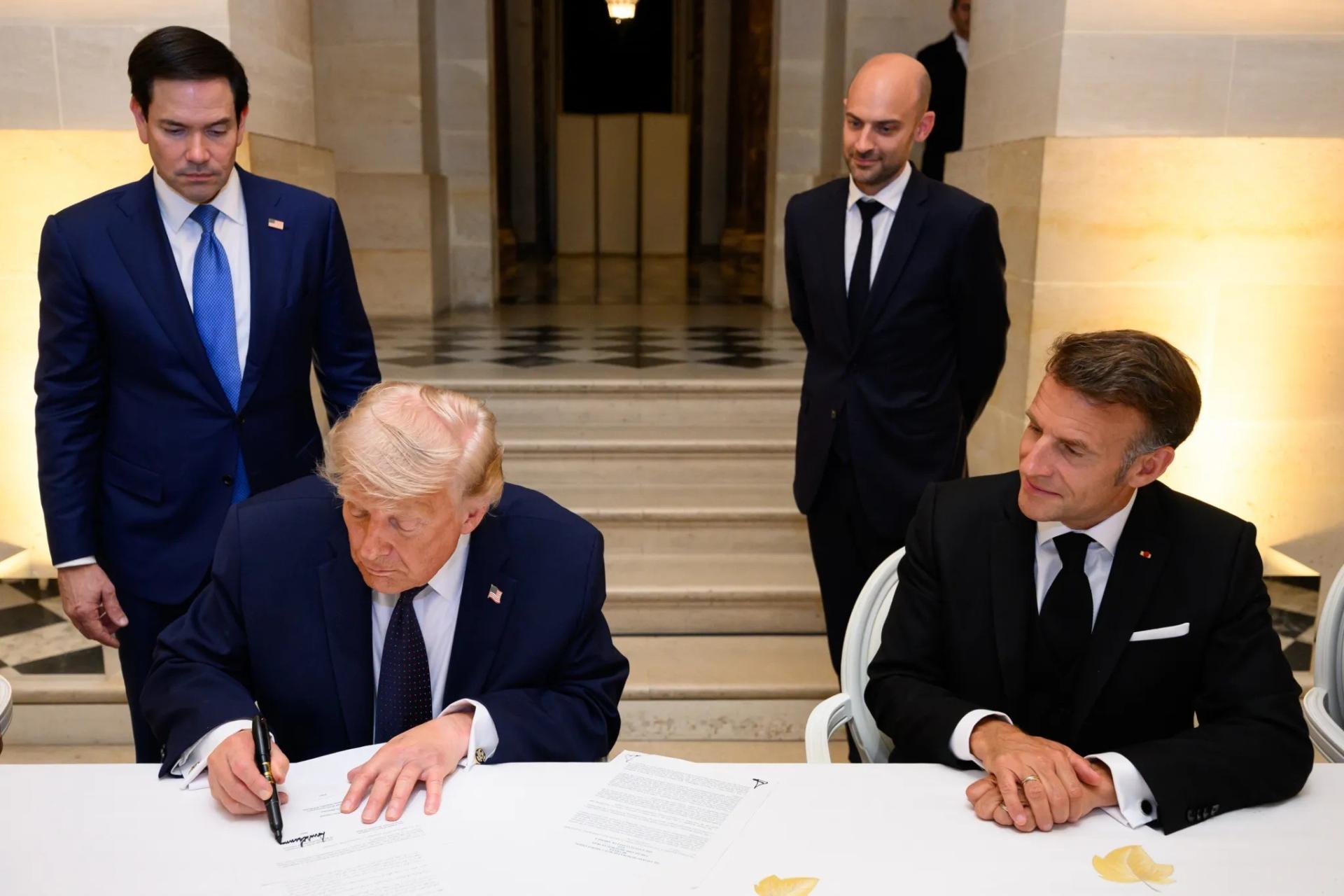 U.S. President Donald Trump signs the Memorandum of Understanding between the Islamic Republic of Iran and the United States at the Palace of Versailles. (Credit: The White House)
Policy Brief | The U.S.-Iran MoU: A Lopsided Arrangement
The Memorandum of Understanding (MoU) signed by the United States and Iran earlier this month is the clearest sign yet that the Trump administration felt it needed an off ramp for the war it launched alongside Israel in late February. From the ambitious aims articulated at the start of the war – end Iran’s nuclear program, destroy its missile program and navy, change its leadership, and improve regional stability – the United States has settled for a set of terms that provide Iran with an economic windfall while demanding little in return. The MoU ends the war and promises to reopen the Strait of Hormuz to maritime traffic. It also contains limited and delayed concessions by Iran on its nuclear program. On all other issues, it is either silent or vague, while the economic benefits it grants to Iran threaten to undo what progress the United States made toward its objectives during the period of high-intensity combat.
___________________
ENTITIES OF CONCERN
An Iranian machine tool company and its CEO have used a network of firms in China, Hong Kong, and Taiwan to procure Taiwanese machine tools for Iran’s military aviation industry.
An Iran-based company; with CEO Javad Alizadeh Hoshyar, has procured computer numerical control (CNC) machines for Iran Aircraft Manufacturing Industries (HESA), an entity subordinate to Iran's defense ministry that manufactures military aircraft and Ababil-series drones.
Joemars Machinery and Electric Industrial Co Ltd
A Taiwan-based machine tools manufacturer; with Mecatron Machinery Co Ltd, used by Control Afzar Tabriz to ship CNC machines and equipment to Iran; China-based subsidiary Changzhou Joemars Industrial Automation Co Ltd is formally owned by a defunct U.S.-based company.
A Hong Kong-based company used by Control Afzar Tabriz as an alternative consignee and intermediary for procurements on behalf of HESA; uses a company secretary associated with an address identified by the U.S. Department of Commerce as posing a high risk of diversion.
___________________
IN THE NEWS
 Bitcoin and U.S. dollars. (Photo Credit: Tasnim News Agency)
How a Crypto Exchange Became a Major Hub for Illicit Iranian Cash | Wall Street Journal
June 24, 2026: Iranian entities moved more than $3.84 billion since 2019 through CoinEx, a Seychelles-based cryptocurrency exchange founded by Chinese engineer Haipo Yang. Wallets hosted by CoinEx received hacked cryptocurrency obtained by the Central Bank of Iran (CBI) and transacted directly with accounts later attributed to Iran’s Islamic Revolutionary Guard Corps (IRGC). To discover the activity, analytical firm TRM Labs traced stablecoins from wallets attributed to the CBI, including funds linked to $1.5 billion stolen by North Korean hackers. The funds progressed through multiple blockchains and cryptocurrencies to wallets hosted by Nobitex, Iran’s largest cryptocurrency exchange, before being transferred to CoinEx accounts and rendered untraceable through a series of additional steps.
CoinEx became Nobitex’s largest foreign counterparty by 2024, after the United States penalized Binance for allowing Iranian customers to use its platform. More than $763 million moved between CoinEx and Nobitex in 2025. Between 2022 and 2025, CoinEx-hosted wallets processed transactions for Alireza Derakhshan, an Iranian individual allegedly involved in an oil sales network sanctioned by the United States in 2025, and Zedcex, a London-registered cryptocurrency exchange connected to IRGC-linked sanctions evader Babak Zanjani. CoinEx denied facilitating direct transactions on behalf of Iranian or sanctioned entities.
Downed US Pilot Reported Seeing Iranian Drones Swarm in ‘Jellyfish’ Formation | CNN
June 23, 2026: A U.S. pilot recalled seeing multiple Iranian drones hover together in formation before he was shot down in Iranian airspace in April, according to four sources familiar with his intelligence debriefing. The pilot reported a formation resembling a jellyfish, with large drones above and smaller drones underneath. The pilot was concussed during the crash, but if his recollection is correct it could indicate that Iran has developed a meshed networking capability. Meshed networking allows multiple drones to be controlled at once by one operator. Russia and China are believed to have the capability, and two CNN sources said that there have been reports indicating that Russia and China have assisted Iran in developing its drone technology.
Iran Sealed Uranium Cache and Placed Mines Amid Fears of US Operation to Seize Material | CNN
June 13, 2026: Iran has fortified the sites containing its highly enriched uranium (HEU) stockpile by collapsing tunnels and mining entrances, according to sources familiar with U.S. intelligence. The U.S. military contemplated an operation to seize the HEU in mid-May, but concluded that the risk was too high. Iran's fortification efforts subsequently continued and increased the time and risk that would be required to retrieve the uranium, even if the retrieval were to be carried out under the terms of a negotiated settlement or by Iran itself. U.S. President Donald Trump said in early June that removal of the HEU would take at least two weeks to complete. A former head of the U.S. National Nuclear Security Administration voiced concern that Iran could claim some of the uranium is irretrievable, thereby obfuscating compliance with any potential agreement to remove it.
__________________
FROM THE LIBRARY
The U.S.-Iran MoU ostensibly ended the war, but military flare-ups and diplomatic tension continued.
- The U.S. and Iranian presidents each separately signed the MoU, the text of which was eventually released to the press – June 18
- In accordance with the MoU, the United States issued a sanctions waiver allowing the unrestricted sale of Iranian oil – June 22
- U.S. and Iranian negotiators met in Switzerland to discuss the MoU’s implementation – June 22
- Iran’s chief negotiator, Parliament Speaker Mohammad Bagher Ghalibaf, traveled to Oman to discuss management of the Strait of Hormuz with Omani officials – June 23
- The United States and the Gulf Cooperation Council countries issued a joint statement rejecting any toll scheme for the Strait – June 25
- Iran attacked a commercial ship transiting the Strait in Omani waters, setting off two days of tit-for-tat strikes between U.S. and Iranian forces – June 27
- The International Maritime Organization (IMO) announced an evacuation plan for the ships stranded in the region and then paused the operation following attacks – June 23 and 25
The IAEA Board of Governors held its regular meeting and discussed the Iranian nuclear issue.
- The Agency released its NPT Safeguards Implementation report, with little new information on the status of Iran’s enriched uranium stockpile – June 4
- IAEA Director General Rafael Grossi reported that the Agency had resumed inspections of the Bushehr nuclear power plant, but was unable to access any other sites – June 8
- France, Germany, the United Kingdom, and the United States together introduced a resolution criticizing Iran for noncompliance with the NPT – June 10
- The resolution was adopted by a vote of 21 to three, with 10 abstentions – June 10
- Iran, China, and Russia issued a joint statement opposing the resolution and blaming the U.S. war for Iran’s lack of cooperation with the Agency – June 10
The United States pursued its “Economic Fury” sanctions campaign prior to signing the MoU.
- The U.S. Treasury Department sanctioned an Iranian network that impersonated U.S. companies in order to obtain software from genuine U.S. firms – May 29
- The Treasury Department froze the assets of several Iranian cryptocurrency exchanges – June 2
- Federal law enforcement officials arrested a U.S.-Iranian businessman for smuggling computer networking equipment to Iran, including to military and nuclear entities – June 3
- The Treasury Department sanctioned a network exporting Iranian liquid petroleum gas and an Iranian exchange house involved in illicit banking networks – June 5
- An Iranian national extradited by Panama pleaded guilty in U.S. court to charges related to illicitly exporting military sonar systems to Iran – June 5
- The Treasury and State Departments sanctioned entities involved in facilitating Iranian purchases of MANPADS from China – June 10