
Publication Type:
- Newsletters
This month’s newsletter aims to bring readers up to date on the status of Iran’s weapon programs one month into the war between Iran and the United States and Israel. The newsletter also features a report examining clandestine uranium enrichment scenarios should Iran retrieve part of its nuclear stockpile and make a dash for a bomb, as well as briefings on the war’s progress provided by the U.S. and Israeli militaries plus government statements and actions related to the closure of the Strait of Hormuz and Iranian attacks on Gulf infrastructure.
Sign up to receive the newsletter in your inbox.
___________________
WEAPON PROGRAM UPDATES
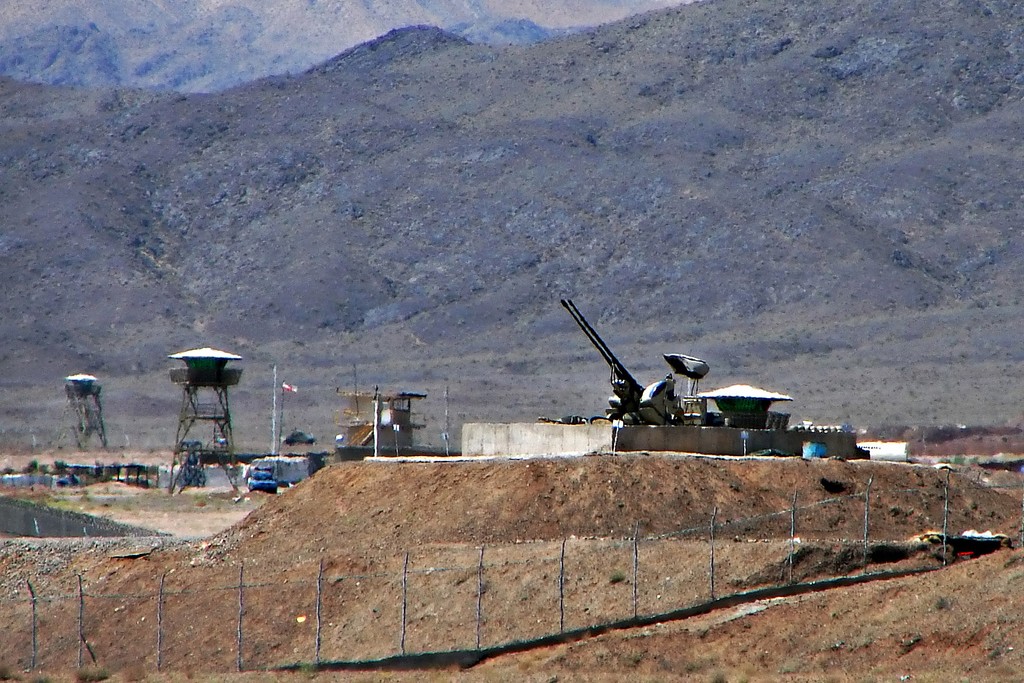 The outskirts of the Natanz nuclear facility in 2006. (Photo Credit: Hamed Saber, CC BY-2.0, via Wikimedia Commons)
Missile
Iran’s missile arsenal has been degraded but not exhausted. Top U.S. commanders claim that daily Iranian missile and drone launches are down approximately 90 percent since the first days of the war, and Israel claims to have neutralized 70 percent of Iran’s missile launchers. Independent analysis of satellite imagery suggests Iran’s ability to produce missile propellant—and therefore to build new missiles—has been temporarily halted due to damage to key facilities.
Yet Iran continues to maintain a baseline rate of fire, and some Iranian missiles have managed to penetrate air defenses and damage military, infrastructure, and civilian targets in Israel and the Gulf states. Iran has made greater use of cluster munition warheads than it did in earlier exchanges of fire and has shown itself to possess ballistic missiles with longer ranges than previously thought. The United States reportedly is able to assess with confidence only that it has destroyed one third of Iran’s stock of ballistic missiles and damaged or rendered inaccessible another third. If accurate, that would likely leave Iran with between a few hundred and a couple thousand missiles available for use before it is constrained by its apparent production bottleneck.
Drone
The status of Iran’s presumably much larger drone arsenal is less clear, though drone storage sites and production facilities have also been targeted by U.S. and Israeli strikes. Long-range suicide drones such as the Shahed-136 have comprised a damaging part of Iran’s strikes on Gulf infrastructure and commercial ships transiting the Strait of Hormuz. In a unique example of a proliferation feedback loop, Russia is also reportedly supplying Iran with drone warfare advice, components, and a pending shipment of Geran-2 drones—an improved version of the Shahed-136 model that Tehran supplied to Moscow early in the Russia-Ukraine war.
Nuclear
The current war has focused less on Iranian nuclear sites, many of which were severely damaged by U.S. and Israeli strikes in June 2025. But the Iranian nuclear program remains a primary concern. Early in the war, Israel struck a compound near Tehran where it said Iranian nuclear scientists had moved their weaponization work following the June strikes. Crucially, more than 400 kilograms of uranium enriched to 60% purity—enough to fuel 10-12 nuclear weapons—remain in Iran, with much of it likely buried in underground tunnels near Esfahan. Accounting for and securing that material, whether through a military operation or a negotiated end to hostilities, is essential to achieving the U.S. war aim of preventing Iran from acquiring a nuclear weapon.
___________________
PUBLICATIONS
Report | Hidden Among the Rubble: Iran’s Post-Strike Weapon Potential
One of the United States’ war aims is to ensure that Iran does not obtain a nuclear weapon. The U.S. and Israeli strikes in June 2025 had already set back Iran’s nuclear program, but left more than 400 kilograms of highly enriched uranium (HEU) inside Iranian territory. Unless the United States mounts an operation to remove it, Iran may attempt to retrieve the HEU and enrich it to weapon-grade at secret sites. This report considers scenarios involving three sizes of sites and differing levels of usable enriched uranium to establish theoretical estimates for how long it might take Iran to manufacture fuel for a small nuclear arsenal in the aftermath of war.
___________________
IN THE NEWS
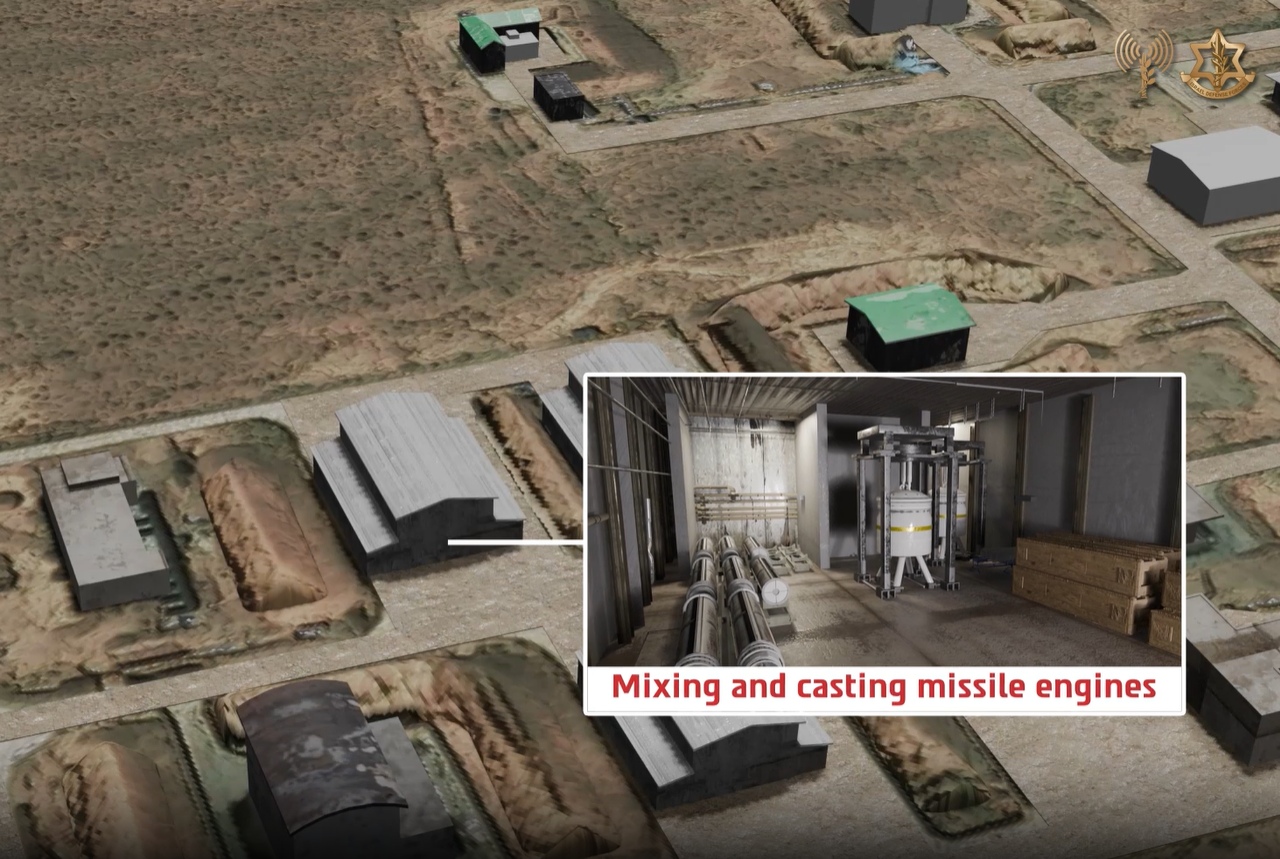 A graphic of a missile propellant production site in Shahroud. (Photo Credit: Israel Defense Forces)
Iran’s Missile Infrastructure Severely Strained After Weeks of Strikes | Washington Post
March 29, 2026: Four facilities used by Iran to manufacture ballistic missile propellant and at least 29 missile launch sites have been damaged by the United States and Israel since the start of the war, according to an analysis of satellite imagery by the Washington Post. The damaged production sites included military complexes at Shahroud and Parchin, where solid missile propellant is produced; Khojjir, which produces both solid and liquid propellant; and Hakimiyeh, which manufactures liquid propellant and missile launchers. Four experts interviewed by the Post assessed that Iran would be unable to produce short- and medium-range ballistic missiles until the facilities are repaired or replaced. Damaged launch sites included the Khorgu missile base on Iran's Gulf coast and the Imam Ali missile base in western Iran. Iran is estimated to possess approximately 30 launch sites in total.
U.S. Can Only Confirm About a Third of Iran's Missile Arsenal Destroyed, Sources Say | Reuters
March 27, 2026: The United States can be certain that it has destroyed approximately one-third of Iran's missile arsenal in the ongoing war, according to sources familiar with relevant U.S. intelligence. Another third has likely been damaged or buried in underground facilities where it is inaccessible. One of the sources claimed U.S. intelligence also indicates that one-third of Iranian drone capability can be assessed with certainty to have been destroyed. A Pentagon official stated that Iranian drone and missile attacks have decreased by about 90% since the start of the war. A senior Israeli military official claimed that more than 335 Iranian missile launchers comprising 70% of Iran's missile launch capacity have been destroyed. On March 26, Iran launched 15 ballistic missiles and 11 drones at the United Arab Emirates (UAE), according to the UAE's defense ministry.
Iran Targeted Diego Garcia Base with Ballistic Missiles | Wall Street Journal
March 20, 2026: Iran launched two intermediate-range ballistic missiles at the joint U.S.-U.K. Diego Garcia military base in the Indian Ocean, according to multiple U.S. officials. One missile failed in flight and the other failed to reach its target after a U.S. warship fired an interceptor missile at it. Diego Garcia is approximately 2,500 miles (4,000 kilometers) from Iran. Iran has previously claimed to have limited the maximum range of its missiles to 1,250 miles (2,000 kilometers).
Russia Sending Drones to Iran, Western Intelligence Says | Financial Times
March 25, 2026: Russia is close to fulfilling a shipment of drones to Iran, according to Western intelligence reports. Iranian and Russian officials began discussing the provision of drones shortly after the outbreak of war between Iran and the United States and Israel. The deliveries are expected to be completed by the end of March. The specific types of drones to be supplied are unknown but would likely consist of unmanned aerial vehicles (UAVs) such as the Geran-2 suicide drone, an improved Russian version of the Iranian Shahed-136 design. Russia has already provided Iran with satellite imagery, targeting data, and other intelligence support.
Israel Army Says It Struck 'Covert Underground' Nuclear Site in Iran | Le Monde
March 3, 2026: The Israeli military said that it struck an underground site where Iranian scientists were covertly developing a nuclear weapon component. According to the Israeli Defense Forces, the site is located on the eastern outskirts of Tehran and is called Minzadehei. The Israeli military said that Iranian nuclear scientists had moved their activities there after Israel and the United States struck several Iranian nuclear sites in June 2025.
Iran Says Nuclear Facilities Have Been Targeted After Israel Said Attacks 'Will Escalate and Expand' | Associated Press
March 27, 2026: The Atomic Energy Organization of Iran (AEOI) said that the Shahid Khondab Heavy Water Complex in Arak and the Ardakan yellowcake production plant in Yazd Province had been targeted in strikes. The Israeli military later claimed responsibility for the attack. The Yazd plant processes natural uranium into a concentrated form, which is a step in preparing it for enrichment. The Arak plant produced heavy water used as a moderator in nuclear reactors, but had been out of operation since Israel struck it in June 2025.
Satellite Image Shows Mysterious Cargo at Iranian Nuclear Site in 2025 | Le Monde
March 28, 2026: Satellite imagery from June 9, 2025 showed an unusual convoy at the entrance to an underground nuclear complex near Isfahan. The convoy contained a flatbed truck carrying 18 large, sealed barrels in a configuration which experts said is consistent with the transport of hazardous or sensitive material. Some analysts theorized that the barrels may have contained highly enriched uranium or other materials used in the nuclear fuel cycle, while others raised the possibility of deliberate signaling or deception by Iran. The timing of the delivery days before Israeli airstrikes on Iranian nuclear facilities suggests Iran may have moved key nuclear assets ahead of the strikes.
__________________
FROM THE LIBRARY
The U.S. military and the Israel Defense Forces (IDF) gave updates on the war’s progress.
- U.S. Chairman of the Joint Chiefs of Staff General Dan Caine said that the United States was shifting its focus from fixed to mobile targets in Iran – March 31
- The IDF claimed a strike on the Arak heavy water complex – March 28
- General Caine said that the United States was targeting storage facilities for mines and anti-ship missiles – March 19
- The IDF claimed that Iran has used missiles armed with cluster munitions against civilian targets in Israel – March 18
- General Caine stated that Iran retained the capability to harm commercial shipping – March 13
- General Caine reported that the United States had struck several production facilities for one-way attack drones – March 10
- The IDF reported that it struck ballistic missile production facilities at Parchin and Shahroud – March 8
- U.S. Central Command commander Admiral Brad Cooper reported that Iranian missile launches had decreased by 90 percent since the war’s first day – March 5
Iran’s closure of the Strait of Hormuz to commercial vessels has cut off a vital route for energy exports, and Iranian attacks on infrastructure in the Gulf have harmed oil and natural gas output.
- G7 foreign ministers rejected Iran’s assertion that it could charge a toll for vessels transiting the Strait – March 27
- The G7 also called for the “immediate and unconditional cessation” of Iranian attacks on Gulf states – March 21
- The U.S. Treasury Department issued a general license exempting the sale of Iranian oil loaded before March 20 from sanctions in an attempt to preserve global supply – March 20
- Thirty countries published a joint statement condemning Iranian attacks on shipping and expressing a willingness to “contribute to appropriate efforts to ensure safe passage through the Strait” – March 19
- Several Arab countries, Pakistan, Turkey, and Azerbaijan issued a joint statement condemning Iranian missile and drone attacks on Gulf Cooperation Council (GCC) countries, Jordan, Azerbaijan, and Turkey – March 19
- Qatar denounced a major Iranian attack on its Ras Laffan liquefied natural gas (LNG) facility, which followed an Israeli strike on Iran’s South Pars gas field – March 18
- The U.N. Security Council adopted a resolution condemning the closure of the Strait and demanding that Iran cease attacks on GCC countries and Jordan – March 11
- The European Union discussed the impact of strikes on energy facilities with Gulf governments – March 9