Publication Type:
- Newsletters
This month’s newsletter features an overview of the laws and executive orders that establish the expansive U.S. sanctions architecture for Iran’s proliferation activities and other malign actions. Through these legal authorities, the U.S. Treasury Department pursues “Operation Economic Outcast,” the sanctions campaign it announced last month with the aim of closing “every financial resource” that supports the Iranian state.
The newsletter also features profiles of China-based entities involved in supplying carbon fiber to a front company for the Islamic Revolutionary Guard Corps (IRGC), as well as news about covert Russian assistance to Iran in cruise missile development, recent trends in Iran’s imports of dual-use goods from China, and Iranian entities’ use of a U.S.-linked cryptocurrency to evade sanctions. Additions to the Iran Watch library include new U.S. and U.K. sanctions announcements, documents from the International Atomic Energy Agency (IAEA)’s Board of Governors meeting, and diplomatic statements related to an unsuccessful attempt to renew the mandate of an Iran sanctions monitoring body at the United Nations Security Council.
Sign up to receive the newsletter in your inbox.
___________________
PUBLICATIONS
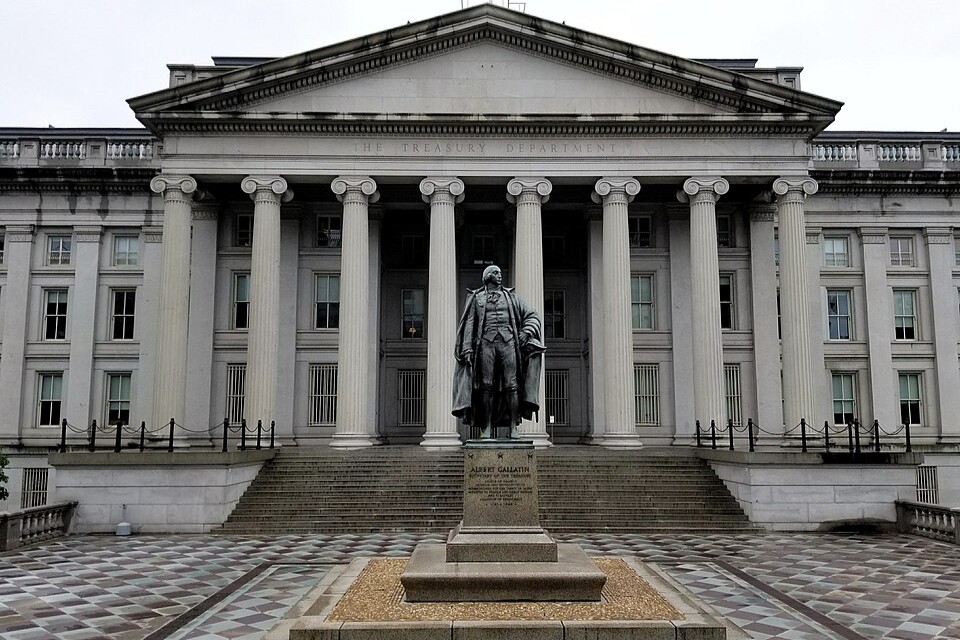 A view of the North entrance of the U.S. Treasury Building in Washington DC. (Image Credit: Sealy j via Wikimedia Commons)
Report | Washington Tightens the Screws
In early 2025, the incoming Trump administration announced the resumption of a “maximum pressure” sanctions policy on Iran following the failure of diplomatic efforts to restore the 2015 nuclear agreement. In August 2026, amidst active hostilities between the two countries and a U.S. naval blockade of Iranian ports, the Treasury Department announced “Operation Economic Outcast” with the aim of closing “every financial resource” that supports the Iranian state.
In this context, it is worth recalling the breadth and chronology of U.S. laws and executive orders that restrict trade and investment with Iran and establish the means that the Treasury Department has at its disposal to pursue its sanctions campaign. These restrictions are part of the long-standing U.S. strategy to contain Iran's efforts to build weapons of mass destruction, to limit Iran’s support for terrorism, and to punish Iran’s human rights abuses. This report summarizes the history and key pieces of this complex sanctions architecture.
___________________
ENTITIES OF CONCERN
The U.S. Treasury Department recently identified a China-based network supplying carbon fiber and other goods with aerospace applications to an Iranian company that carries out procurement on behalf of the IRGC Aerospace Force.
Hitex Insulation Ningbo Company Limited
A supplier of high-temperature fabrics and textiles; sought to supply carbon fiber, honeycomb fabric, and other aerospace-grade materials to Pishgam Electronic Safeh Company (PESC), a company that has procured unmanned aerial vehicle (UAV) components for the IRGC Aerospace Force Self-Sufficiency Jihad Organization (IRGC ASF SSJO).
Ningbo Hitex Composite Materials Co., Ltd.
An unsanctioned company affiliated with Hitex Insulation Ningbo Company Limited; produces aramid, basalt, carbon, and glass fibers, as well as epoxy resins; claims to serve the aerospace industry.
Executive director and legal representative of Hitex Insulation Ningbo Company Limited and CEO of Ningbo Hitex Composite Materials Co., Ltd.; manages Hitex Insulation Ningbo Company's finances, purchases, and sales.
___________________
IN THE NEWS
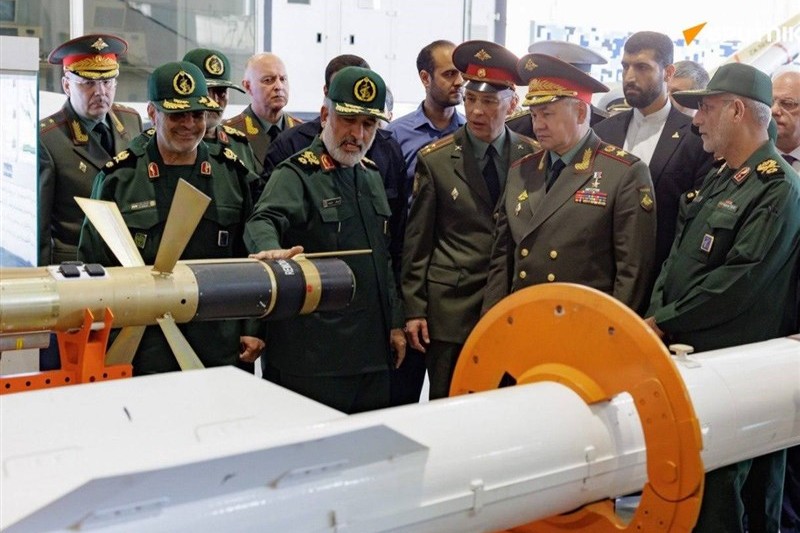 Then-Russian defense minister Sergei Shoigu visits the IRGC Aerospace Force headquarters in Tehran in September 2023. (Image Credit: Tasnim News Agency)
Russia Secretly Helping Iran Develop Supersonic Cruise Missiles | Financial Times
September 1, 2026: Russia has been assisting Iran to develop ramjet engines for supersonic cruise missiles since 2023 through a covert program organized by Russian state arms exporter Rosoboronexport and carried out by missile manufacturer NPO Mashinostroyenia. Officials from the Russian companies traveled to Iran in 2023 in advance of signing a contract with Iran's Ministry of Defense and Armed Forces Logistics (MODAFL) in November of that year.
Correspondence obtained by the Financial Times in April 2025 showed that the two sides were exchanging technical information about Iranian flight tests and that Rosoboronexport proposed sending additional specialists to Iran. Additional correspondence from June 2026 indicated that Rosoboronexport and MODAFL were planning further discussions on technical reports prepared by the Russian side. Ramjet engines can enable cruise missiles to fly approximately four times faster than turbojet-powered missiles and could be used for either anti-ship or land-attack cruise missile systems. Iran does not currently possess ramjet technology but declared its intention to develop it in 2016.
Iran Has a Secret Weapon in Its War with America: Help from China | Wall Street Journal
September 23, 2026: Iranian customs data show approximately 1,300 shipments of dual-use goods with applications in missile guidance systems and drones from China to Iran's Ministry of Defense and Armed Forces Logistics (MODAFL) in the first six months of 2026. The goods shipped included GPS tracking devices, electric motors, and aircraft engine parts and largely arrived by air at Imam Khomeini International Airport in Tehran. The air cargo shipments coincided with an expansion of Mahan Air flights from Beijing, Guangzhou, and Shanghai to Tehran.
Several Chinese companies also supplied Iran with chemicals used to manufacture missile propellant by sea prior to the imposition of the U.S. naval blockade on Iran in early 2026. One U.S.-sanctioned company, Haokun Energy, told a sanctioned Iranian importer in December 2025 that it had coordinated with Chinese authorities to "confidentially" obtain required licenses for the export of sodium perchlorate to Iran and set up a shell company to carry out the transaction. A U.S. Treasury Department spokesperson said the department maintains a communication channel with Chinese counterparts to address Iran-related activity in China's jurisdiction.
Senate Investigation Finds Rampant Use of Tether’s Stablecoin by Iranian Regime | Wall Street Journal
September 28, 2026: A report issued by the Senate Permanent Subcommittee on Investigations found that 84% of cryptocurrency wallets sanctioned by the United States and Israel in connection with Iran transacted primarily in USDT, a stablecoin pegged to the U.S. dollar that is issued by the cryptocurrency company Tether. In one instance, leaked documents appeared to show an Iranian company purchasing tens of millions' worth of USDT on behalf of the Central Bank of Iran (CBI). Other data from a blockchain analytics firm indicate a decline in the use of USDT by Iran-linked wallets between 2024 and 2026, but the Senate report states that Tether cryptocurrencies were still commonly used by wallets recently sanctioned by the United States, including one linked to the CBI and another used by an Iranian oil sales network. The report was prepared by the subcommittee's ranking member, Senator Richard Blumenthal (D-Connecticut).
__________________
FROM THE LIBRARY
The United States announced new sanctions actions against Iran as part of its Operation Economic Outcast, while the United Kingdom also took its own sanctions steps related to Iran’s nuclear program.
- The U.S. Treasury Department sanctioned entities involved in shadow banking for Iran – August 28
- The Treasury Department’s Financial Crimes Enforcement Network (FinCEN) proposed a rule revoking U.S. correspondent account access for a financial institution in the United Arab Emirates – September 1
- The Treasury Department also sanctioned a Turkey-based bank and its two subsidiaries – September 4
- Additional U.S. sanctions targeted 27 Iranian airlines and several entities associated with Mahan Air – September 8
- FinCEN issued an alert to financial institutions about Iranian procurement activity related to the aviation industry – September 8
- The United Kingdom introduced legislation to restore sectoral sanctions on Iran that the U.K. had previously lifted under the JCPOA – September 8
- An unnamed U.S. person agreed to pay $1.4 million to settle liability for apparent violations of U.S. sanctions on Iran – September 10
- The Treasury Department sanctioned entities supporting Iran-backed militias in Iraq – September 10
- FinCEN released guidance for whistleblowers to report Iran sanctions violations – September 10
- The Treasury Department established a blanket presumption of denial for license requests under the Iranian Transactions and Sanctions Regulations (ITSR) – September 10
- The United States placed additional sanctions on Russia’s VTB Bank for helping Iran to evade sanctions – September 14
- The Treasury Department froze the assets of a cryptocurrency exchange controlled by Iranian financier Babak Zanjani – September 17
- Turkey and the UAE curtailed the activities of branches of major Iranian banks operating on their territories – September 18 and 23
- The United Kingdom applied a presumption of denial to license applications by designated Iranian banks operating in the U.K. – September 23
- The State Department sanctioned a Russian shipping company and military aircraft manufacturer for arms transfers to Iran – September 29
- The Treasury Department froze the assets of a China- and Pakistan-based network supplying military equipment to Iran’s defense ministry – September 29
The IAEA held its September Board of Governors meeting and released its latest report on NPT safeguards implementation in Iran.
- In its NPT safeguards report, the Agency said it had received no information from Iran regarding the status of its nuclear program – September 1
- IAEA Director General Rafael Grossi said in his introductory statement that the Agency was therefore unable to discharge its safeguards responsibilities – September 7
- Several IAEA member states put forward a resolution referring the Iranian nuclear issue to the U.N. Security Council – September 9
- The United States, France, Germany, and the United Kingdom urged the board to adopt the resolution, which it did by majority vote – September 10
- China opposed the resolution, reiterating its contention that the “snapback” of U.N. restrictions on Iran in 2025 was invalid – September 10
- The United States and the E3 also expressed their concern that the IAEA could not verify that there had been no diversion of Iranian nuclear material – September 10
Russia and China vetoed a draft U.N. Security Council resolution proposed by the United States to renew the mandate of the expert panel monitoring compliance with U.N. sanctions on Iran.
- The United States and the United Kingdom called on Iran to comply with its NPT safeguards obligations at a Security Council meeting on the Iranian nuclear issue – September 10
- Russia’s U.N. ambassador repeated Moscow’s claim that the snapback of U.N. nuclear sanctions on Iran was invalid – September 10
- Russia returned to this procedural claim to justify its veto of the draft resolution a week later – September 17
- The United Kingdom deplored the Russian and Chinese vetoes and tied them to Russia’s 2024 veto of the U.N. panel monitoring sanctions on North Korea – September 17