
Publication Type:
- Newsletters
This month’s newsletter features a report about the counterproliferation lessons from the China-linked spread of a German-designed engine that powers Iran’s Shahed-136 suicide drones, as well as news about the U.S. seizure of weapon components from a ship bound to Iran from China, Iranian money laundering through the United Arab Emirates to support Hezbollah, and the use of Western-made goods by a company linked to the Iranian military’s nuclear weapons research.
Also featured are profiles of multiple entities involved in Iran’s acquisition and proliferation of Limbach drone engines. Additions to the Iran Watch library include a sanctions list update and guidance documents published by the Australian government.
Sign up to receive the newsletter in your inbox.
___________________
PUBLICATIONS
 Credit: Wisconsin Project
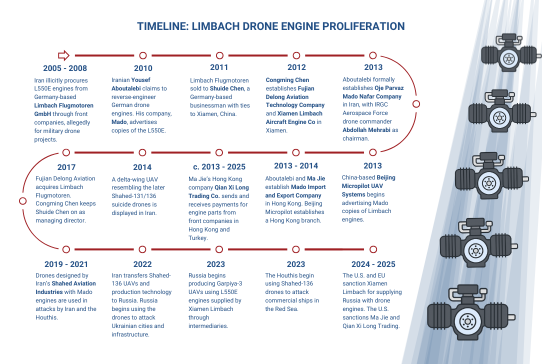
Report | The Cat’s Out of the Bag: Counterproliferation Lessons from the Curious Case of Limbach Engines
The destructive spread of the Iranian-designed Shahed-136 suicide drone from the Red Sea to Ukraine has been one of the most consequential and instructive proliferation cases in the past decade. To fly, the drone uses a piston engine designed by a small German company controlled since at least 2017 by Chinese investors. This report traces the proliferation of that engine, and with it Shahed suicide drones, which quietly ramped up in parallel with a Chinese company’s acquisition of the German firm before bursting into view globally with Russia’s 2022 invasion of Ukraine, Tehran’s decision to supply Moscow with drones, and Russia’s successful push to mass produce its own version of the Shahed-136 with that Chinese company’s help.
The report then outlines the policy lessons that can be drawn from the engines’ proliferation and offers recommendations to prevent the production of sensitive technology from getting out of Western control. These lessons include the need for export control regimes to have a geographic scope beyond the targeted end-use countries; the importance of screening foreign investments in Western firms that produce widely traded dual-use goods; and the imperative of using targeted sanctions to hold the owners and affiliates of sanctions-evading companies to account.
___________________
ENTITIES OF CONCERN
Iran’s acquisition, reverse-engineering, and onward proliferation of Western-designed drone engines has been enabled by a network of entities based in Iran and China.
An Iranian company that specializes in the design and manufacture of aircraft, including unmanned aerial vehicles (UAVs); subordinate to the Islamic Revolutionary Guard Corps Aerospace Force; involved in the production of Shahed-series UAVs.
An Iran-based company specialized in manufacturing UAV components; has helped Abdollah Mehrabi acquire UAV engines for the Self-Sufficiency Jihad Organization of the IRGC Aerospace Force; manufactures UAV engines reverse-engineered from foreign models.
Managing director of Oje Parvaz Mado Nafar Company; has procured UAV engines for the IRGC Navy, Iran Aircraft Manufacturing Industries (HESA), Qods Aviation Industries (QAI), and other Iranian military entities; has registered companies in China.
Beijing MicroPilot UAV Flight Control Systems
A China-based company that sells complete UAVs as well as autopilot systems and engines for UAVs; sells engines manufactured by Oje Parvaz Mado Nafar Company, including unlicensed copies of engines originally produced in Europe that have been used by the Houthis.
___________________
IN THE NEWS
 U.S. Marines conduct fast-rope training aboard the USS Boxer in the Indo-Pacific Command area of operations. (Photo Credit: Sgt. Joseph Helms, U.S. Marine Corps)
U.S. Forces Raid Ship, Seize Cargo Headed to Iran from China | Wall Street Journal
December 12, 2025: U.S. special operations forces boarded a ship in the Indian Ocean in November and seized dual-use items bound from China to Iran. According to U.S. officials, the seized items had applications in conventional weapons and were being delivered to companies that procure goods for Iran's missile program. The cargo was destroyed after being seized.
Iranian Funds for Hezbollah Are Flowing Through Dubai | Wall Street Journal
November 27, 2025: Iran has sent hundreds of millions of dollars to Hezbollah since late 2024 using money exchanges and other companies located in Dubai in order to help Hezbollah rebuild after its war with Israel. The transactions are often carried out using the hawala system of parallel accounts between dealers in Dubai and Lebanon. According to Arab officials, Iran has also sent couriers with small amounts of cash and jewelry to avoid Lebanese airport controls that have been tightened as a result of the Israel-Hezbollah ceasefire agreement. According to a senior U.S. official, the United States is also concerned about funds being smuggled to Hezbollah through Turkey and Iraq and wants Lebanon to shut down the Hezbollah-linked financial institution Al-Qard Al-Hassan.
Iranian Nuclear Scientists Sell Products with Croydon-made Parts | Financial Times
November 25, 2025: Imen Gostar Raman Kish, a company controlled by senior officials in Iran's Organization of Defensive Innovation and Research (SPND), a military nuclear research institute, advertises equipment containing radiation-detection tubes manufactured by U.K.-based company Centronic Ltd. The Mindex Center, the export agency of Iran's Ministry of Defense and Armed Forces Logistics (MODAFL), also advertises the same equipment. The chairman and vice-chairman of Imen Gostar are both senior SPND officials sanctioned by the United States, and its CEO traveled to Russia in 2024 as part of an Iranian delegation seeking technologies usable in nuclear weapons development. Imen Gostar also claims to sell plastic-scintillator detectors that contain components produced by U.S.-based company Eljen Technology as well as a photomultiplier tube produced by a brand controlled by Exosens, Centronic's France-based parent company. There is no evidence that the Western manufacturers knowingly sold the components to Iran.
__________________
FROM THE LIBRARY
Australia implemented the snapback of United Nations sanctions on Iran.
- The Ministry of Foreign Affairs and Trade promulgated updated Iran sanctions regulations – December 11
- The Ministry also published a reference document outlining the framework of Australia’s Iran-related sanctions – December 12
- The Australian government published advisory notes on Iranian procurement networks, prohibited exports to Iran, and the sanctions risks associated with Iranian shadow banking networks – December 12