Publication Type:
- Newsletters
This month’s newsletter features an article about a China-based company that marketed engines used in the Iranian-designed Shahed-136 drone to Tehran in the early days of the U.S.-Iran war. The company is connected to a family of companies headquartered in Xiamen, China, that had previously been implicated in supplying the same drone engines to the Russian military.
The newsletter also features profiles of key entities in that corporate family, as well as news about Iran’s efforts to rebuild its missile and drone arsenals, diplomatic angling over the fate of Iran’s enriched uranium stockpile, and the Islamic Revolutionary Guard Corps (IRGC)’s procurement of Chinese satellite antenna equipment through a front company in the United Arab Emirates. Additions to the Iran Watch library include official statements related to the U.S.-Iran war and new sanctions announcements.
At the time of publication, reports were surfacing about a possible U.S.-Iran peace agreement, but the text of such an agreement had not been formally released.
Sign up to receive the newsletter in your inbox.
___________________
PUBLICATIONS
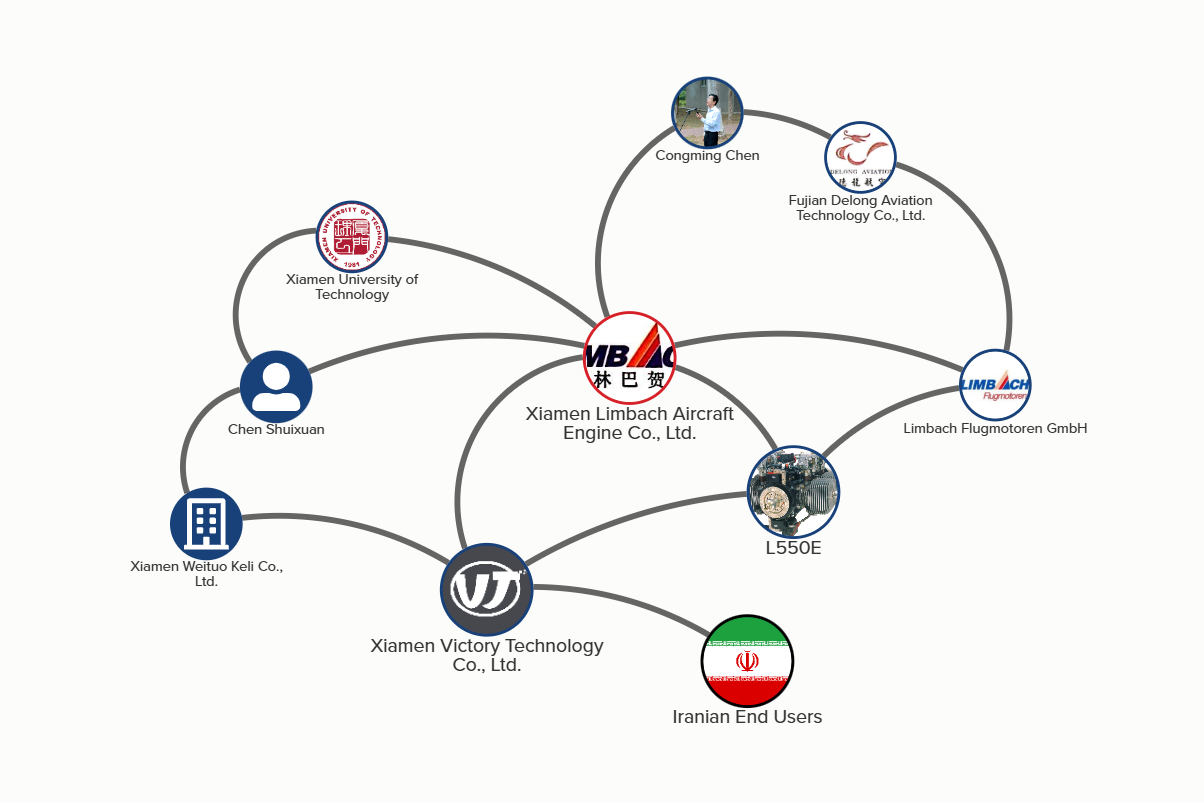 A visualization of the Xiamen Limbach corporate family. (Credit: Wisconsin Project)
On May 5, the Wall Street Journal reported that a Chinese company called Xiamen Victory Technology was soliciting potential Iranian customers with offers to sell Limbach L550 engines. The engines are used in the notorious Iranian-designed Shahed-136 suicide drone employed by Iran, Russia, and the Houthis to strike shipping and infrastructure from the Red Sea to Kyiv. Iran Watch had received this email solicitation two months earlier and shared it with the Journal. Further investigation revealed connections between the sender and a family of companies headquartered in Xiamen that was implicated in supplying the same engines to the Russian military in 2024 and was the subject of a December 2025 Iran Watch report.
___________________
ENTITIES OF CONCERN
A corporate family based in China and extending to Germany has supplied the engines used in Shahed-136 unmanned aerial vehicles (UAVs) to Russia and likely Iran. This Iran-designed UAV was developed by Shahed Aviation Industries for the Islamic Revolutionary Guard Corps (IRGC) Aerospace Force.
Xiamen Victory Technology Co., Ltd.
A China-based supplier of Limbach light aircraft engines; has attempted to sell UAV engines to Iran; likely used as a front company by Xiamen Limbach Aircraft Engine Co., Ltd., which is suspected of sharing engine designs with entities producing Iranian UAVs.
Xiamen Limbach Aircraft Engine Co., Ltd.
A China-based engine producer; suspected by the European Union of sharing the L550 engine design with entities involved in producing engines for Shahed-136 UAVs; involved in a procurement and manufacturing network for the Russian military-industrial complex.
A China-based businessman; controls Xiamen Limbach Aircraft Engine Co., Ltd.; through China-based Fujian Delong Aviation Technology Co., Ltd., also controls Germany-based company Limbach Flugmotoren GmbH, whose products include the L550 series of engines.
___________________
IN THE NEWS
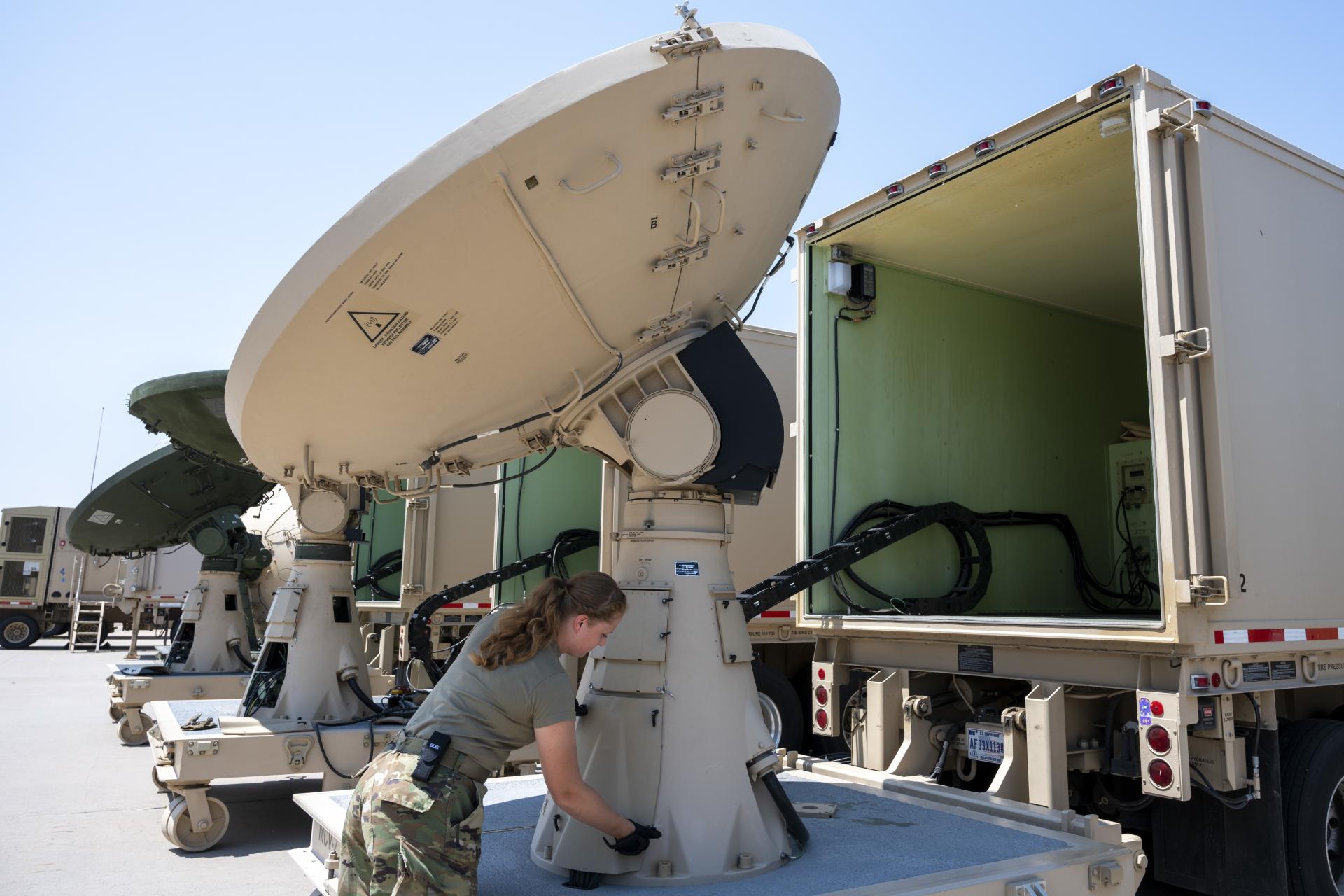 A U.S. Air Force sergeant performs maintenance on a mobile satellite antenna in 2021. (Photo Credit: Master Sgt. Amanda Geiger, U.S. Air National Guard)
Iran’s Guards Used UAE Company to Buy Military Satellite Equipment | Financial Times
May 24, 2026: The Islamic Revolutionary Guard Corps (IRGC) Aerospace Force imported approximately 1.8 tons of satellite antenna equipment in late 2025 via the United Arab Emirates-based company Telesun. The goods, a motorized satellite antenna and related accessories, arrived in a single shipment. A Chinese container ship made the first leg of the delivery from Shanghai to Dubai in August. The container was then transferred to an Iranian vessel, which delivered the shipment to the Iranian port of Bandar Abbas while falsifying its transponder signal to show the vessel as located in the Gulf of Oman. The shipment's consignee was Ertebatat Faragostar Kish (EFK), an Iranian telecommunications company working for Saman Industrial Group, which was sanctioned by the United States in 2023 for serving as a front company for the IRGC Aerospace Force's Self Sufficiency Jihad Organization. The delivery's Iranian shipping agent was Blue Calm Marine Services, which was also sanctioned by the United States in 2023 for facilitating shipments of missile-related goods to Iran's defense ministry.
Supreme Leader Says Enriched Uranium Must Stay in Iran, Iranian Sources Say | Reuters
May 21, 2026: Iranian Supreme Leader Mojtaba Khamenei issued a directive prohibiting Iran's stockpile of enriched uranium from being removed from the country, according to two senior Iranian sources. The United States has insisted publicly that Iran will not be allowed to retain its highly enriched uranium (HEU), including more than 440 kilograms enriched to 60% purity. One of the Iranian sources said that it could be possible to dilute the HEU under the supervision of the International Atomic Energy Agency (IAEA).
May 21, 2026: U.S. intelligence assessments indicate Iran restarted drone production during its April ceasefire with the United States. According to a U.S. official, Iran could fully reconstitute its attack drone capability in as soon as six months and has exceeded timelines previously estimated by U.S. intelligence agencies. According to other CNN sources and Israeli Prime Minister Benjamin Netanyahu, China has provided Iran with components usable in missile production, which the Chinese foreign ministry denied. U.S. intelligence reports also indicate that Iran retained a large portion of its coastal defense cruise missiles after the fighting in March. U.S. Central Command commander Admiral Brad Cooper testified to the House Armed Services Committee that 90% of Iran's defense industrial base had been destroyed during the U.S. bombing campaign.
__________________
FROM THE LIBRARY
The war between Iran, the United States, and Israel remained in a low-intensity phase, but with occasional flare-ups.
- The United States launched, but later suspended, an effort to guide commercial vessels through the Strait of Hormuz – May 3
- Iran responded with strikes on Gulf energy infrastructure, which France condemned – May 5
- China urged negotiations between the United States and Iran following President Trump’s visit to Beijing – May 15
- U.S. Central Command commander Admiral Brad Cooper testified to Congress that the U.S. military had damaged 85% of Iran’s drone, missile, and naval defense industrial base – May 19
- France, Pakistan, and the United Kingdom condemned an apparent Iranian attack on the United Arab Emirates’ Barakah nuclear facility – May 18 and 19
- Russia’s foreign ministry hedged when asked about whether Iran might transfer its enriched uranium to Russia – May 21
- U.S. CENTCOM claimed to have turned around 100 vessels while enforcing the U.S. blockade of Iranian ports – May 23
- CENTCOM said that U.S. and Iranian forces exchanged fire on May 27 and Iran launched a ballistic missile at Kuwait – May 28
The United States continued its “Economic Fury” sanctions campaign.
- The U.S. Treasury and State Departments sanctioned a Chinese petroleum terminal operator and financial facilitators involved in settling Chinese purchases of Iranian oil – May 1
- The Treasury Department’s Office of Foreign Assets Control issued an alert about the sanctions risks of complying with Iranian toll schemes for the Strait of Hormuz – May 1
- The United States sanctioned Iraq’s deputy oil minister for facilitating the diversion of oil sales to benefit Iran – May 7
- The State Department sanctioned Chinese companies that provided satellite imagery to Iran – May 8
- The Treasury Department targeted a network procuring air defense systems and missile and drone components from China – May 8
- The Treasury Department sanctioned front companies supporting IRGC oil exports to China – May 11
- The United States froze the assets of illicit Iranian banking and shipping networks – May 19
- The Treasury Department sanctioned Iran’s ambassador to Lebanon for impeding the disarmament of Hezbollah – May 21
- The State Department offered rewards for information that can be used to disrupt the IRGC’s and Hezbollah’s financial networks – May 11 and 21
- The Treasury and State Departments sanctioned entities based in China, Hong Kong, India, Qatar, and Singapore involved in Iranian military oil sales – May 28